

My daughter grabbed it at the pharmacy the afternoon I came home from the hospital after my wrist fracture. It was a standard hook-handle cane, the kind they keep in a bin near the blood pressure cuffs. Chrome tube, rubber tip, adjustable height. She paid maybe ten dollars. I thanked her and told her it was fine.
That was two years before my second fall.
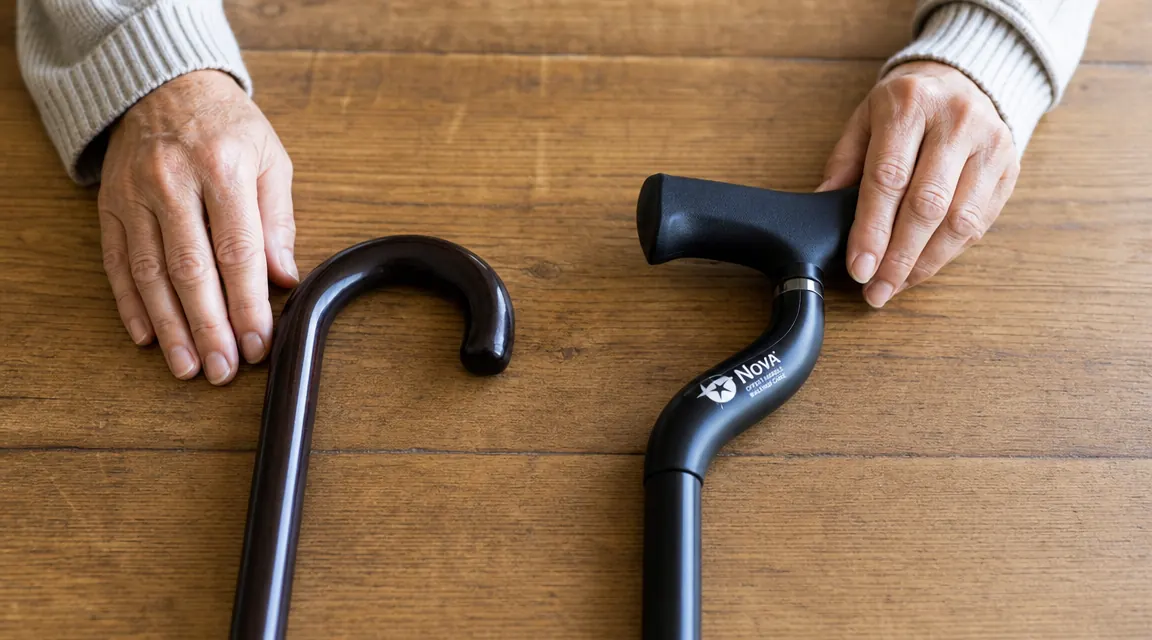
I don't tell you that to scare you. I tell you because I walked around with that cane every single day thinking I was doing the right thing. I had a cane. I was being careful. What more could I do? What I didn't understand, and what nobody at the pharmacy told me, was that the cane I was using put my wrist at an angle that made me less stable, not more. The handle sat directly over the tip, so every time I leaned on it, I was putting downward pressure on a joint that wasn't designed to hold weight that way. It was like trying to balance on the skinny edge of a ruler.
My physical therapist, a no-nonsense woman named Karen who had been doing PT for over twenty years, figured this out in about sixty seconds. She watched me walk down the clinic hallway, held up one hand, and said, "Stop. Can I see that cane?" She turned it over, looked at the handle, and set it on a chair. "This is designed for someone who needs very light support. You need actual support. These are two different things."
She watched me walk down the hallway, held up one hand, and said: "This is designed for someone who needs very light support. You need actual support. These are two different things."
She explained what an offset handle does. On a standard cane, the handle is directly above the shaft, so the load you put on it tries to tip the whole cane forward. On an offset cane, the handle is set back over the shaft, so your weight pushes straight down through the tube, into the tip, into the floor. You get a stable base instead of a tipping point. She said for anyone using a cane as a primary mobility aid, rather than just for occasional balance checks, an offset handle is almost always the right design.

I went home and did what I always do when someone tells me something I should have known sooner. I read everything I could find. I looked at studies on cane mechanics and gait patterns. I read every review I could find on offset canes. I landed on the NOVA Heavy Duty Offset Handle Cane based on its weight rating, its adjustment range, and the number of reviews from people who were using it daily rather than occasionally. It has a 500-pound weight capacity, which told me the engineering was built for real load-bearing, not decorative support.
If you're using a standard hook-handle cane for daily walking, read this first.
The NOVA offset cane is what my PT recommended after two years of me using the wrong tool. It's height-adjustable, rated for 500 lbs, and it puts your weight over the shaft the way it's supposed to be. Check current pricing and availability on Amazon.
Amazon Check Today's Price on Amazon →When the NOVA arrived I noticed the difference before I even stood up with it. The handle itself felt more solid. The foam grip sat at a more natural angle for my hand. When I stood and put weight on it, there was no wobble and no sense that the cane wanted to tip. I walked from my kitchen to my front door and back, which I had been doing for two years with the pharmacy cane, and I could feel that my elbow was no longer locked straight. My arm bent slightly, the way it's supposed to, instead of stiffening to compensate for a shaky base.
It took me about a week to fully trust it. That's not a knock on the product. That's just the honest account of what it's like to adjust your gait after two years of doing it wrong. Karen had warned me: you'll feel strange at first because your muscles have adapted to compensating. Give it ten days. She was right.

I've been using the NOVA for over two years now. I've taken it to the grocery store, to my book club, to a trip I took with my daughter to see the ruins at Chaco Canyon last fall, which involved uneven terrain and a lot of slow, careful walking. It went with me on the plane as a carry-on. It held up. The rubber tip has worn down and I replaced it once, which cost almost nothing and took about thirty seconds.
What I'd Tell You If We Were Sitting at My Kitchen Table
If your parent is using a standard hook-handle cane that someone grabbed at the drugstore, please don't assume that any cane is the same as any other cane. I made that assumption for two years and it cost me. The cane design matters, the height matters, and the fit to the person matters. The pharmacy bin is a fine place to get a thermometer. It is not a fine place to get your primary fall-prevention tool.
If you yourself are in your sixties or seventies and you're using a cane every day, ask your physical therapist to watch you walk with it. This takes less than five minutes. Karen spotted my problem on the first pass down the hallway. If you don't have a PT, look at the handle on your cane. If it sits directly above the shaft in a hook shape, you have a standard cane. If the handle is set back so the shaft angles forward from it, you have an offset. For most people who lean on a cane regularly, the offset is the right design.
That's all. No dramatics. I just spent two years using the wrong tool without knowing it, and I don't want you to do the same. The NOVA offset cane is what I use now, and it is what I will keep using. More than anything else I've tried, it gave me back the confidence that my feet and my cane were working together instead of against each other. That's worth more than I can put a number on.
Two years in, the NOVA offset cane is still the one thing in my daily routine I wouldn't trade.
If you or someone you love is ready to move from a pharmacy cane to something actually designed for daily mobility support, check what the NOVA is going for on Amazon today. It ships fast and the adjustment is straightforward.
Amazon Check Today's Price on Amazon →