

Two years ago I broke my wrist in a fall on my front porch and my leg in a separate fall six months after that. When you have been through two falls in less than a year, a cane is not optional anymore. It becomes the difference between going outside and staying inside. I had been through two drugstore canes that wobbled, pinched my palm, and left my wrist aching by mid-morning. My physical therapist looked at one of them and said, plainly, that it was the wrong tool. She pointed me toward an offset-handle design. I bought the NOVA Heavy Duty Offset Handle Cane and I have not put it down since.
I am 73 years old. I lost 48 pounds after those two falls, mostly through dietary changes and the physical therapy I was already doing. I walk every day now, sometimes just to the mailbox, sometimes to the corner and back, sometimes through the grocery store and the library. The NOVA cane comes with me every single time. Here is what two years of daily use actually looks like.
The Quick Verdict
The NOVA offset cane is the most comfortable, stable cane I have owned. The ergonomic handle is a genuine improvement over a standard crook handle, the 500 lb weight rating gives real confidence, and the height adjustment is the easiest I have used. The rubber tip wears out faster than I would like, and the wrist strap is nearly useless, but neither issue changes my daily recommendation.
Amazon Check Today's Price →Your wrist should not ache after a walk to the mailbox
If a standard cane is making your hand or wrist sore, the offset handle design distributes your weight differently. The NOVA is the cane my PT recommended and the one I have used for two years.
Amazon Check Today's Price on Amazon →How I Have Used It
From the first week, I used the NOVA on pavement, grass, tile floors, hardwood, and carpet. I walk on flat suburban sidewalks most mornings. My driveway has a slight slope and I use it there too. Once a month or so my daughter drives me to the botanical garden near her house, which has packed gravel paths and a few gentle hills. The cane has gone on all of it.
I set the height the first afternoon I had it. My PT had told me the correct height for a cane is so that your elbow bends about fifteen degrees when you grip the handle while standing tall. The NOVA adjusts in one-inch increments with a push-button collar. I found the right height in under two minutes and have not touched the adjustment since. At five feet four inches, I am on the shorter end of the adjustment range, and I had no problems.
Weight capacity matters to me personally because I was over 200 pounds for most of the past two years and I put real weight through this cane on steep curb cuts and uneven ground. The 500 lb rating gave me confidence I had never felt with a lighter drugstore cane. I am not saying I tested it to the limit, but knowing the engineering margin is there changes how you walk. You stop second-guessing the cane and you start walking.
What the Offset Handle Actually Changes
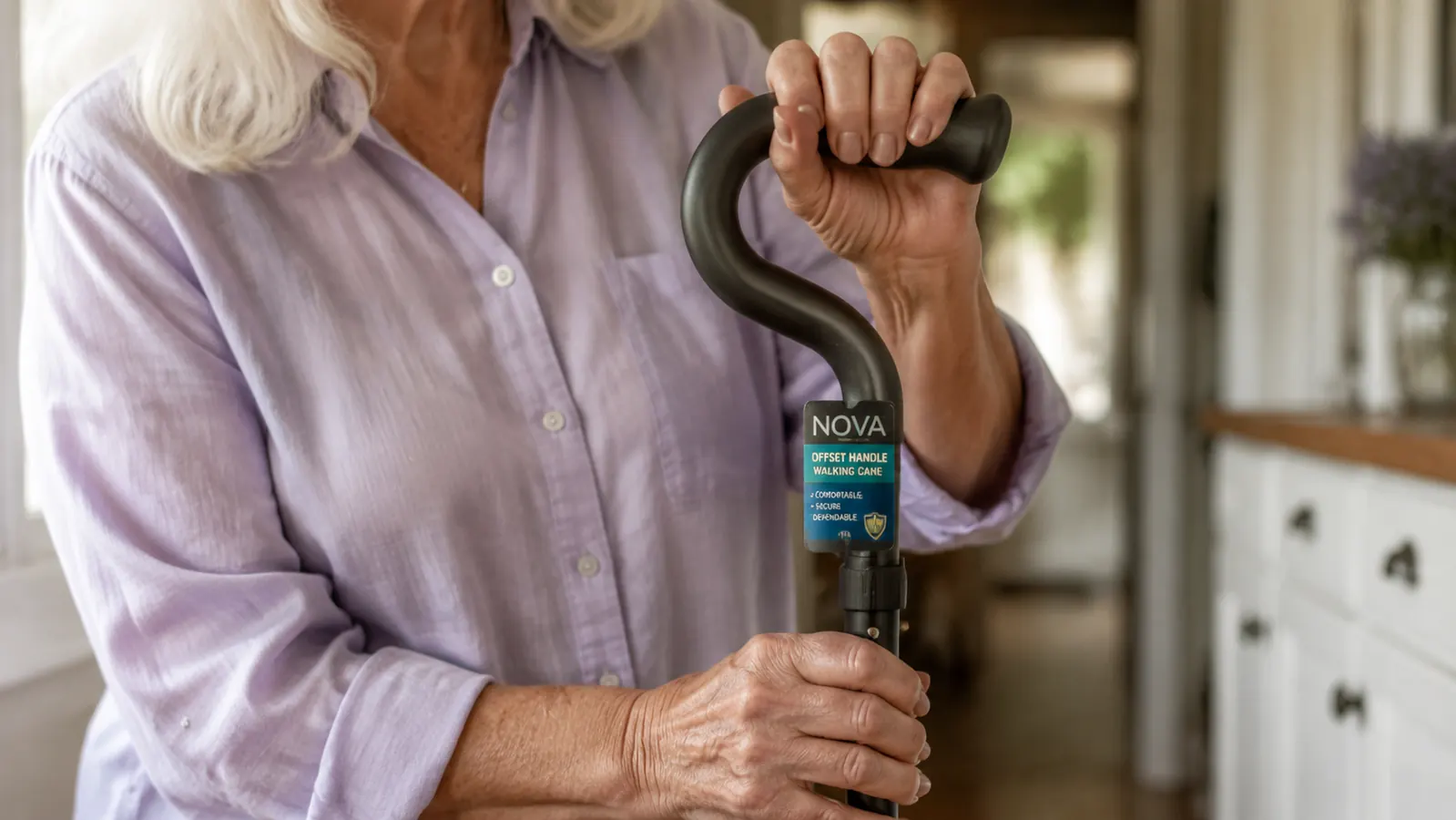
A standard cane has a crook or T-handle directly above the shaft. When you grip it and lean, your wrist bends inward to compensate. After fifteen or twenty minutes, that position causes aching in the wrist, the base of the thumb, and sometimes up into the forearm. I know because that is exactly what happened with my two previous canes. I thought aching wrists were just part of using a cane.
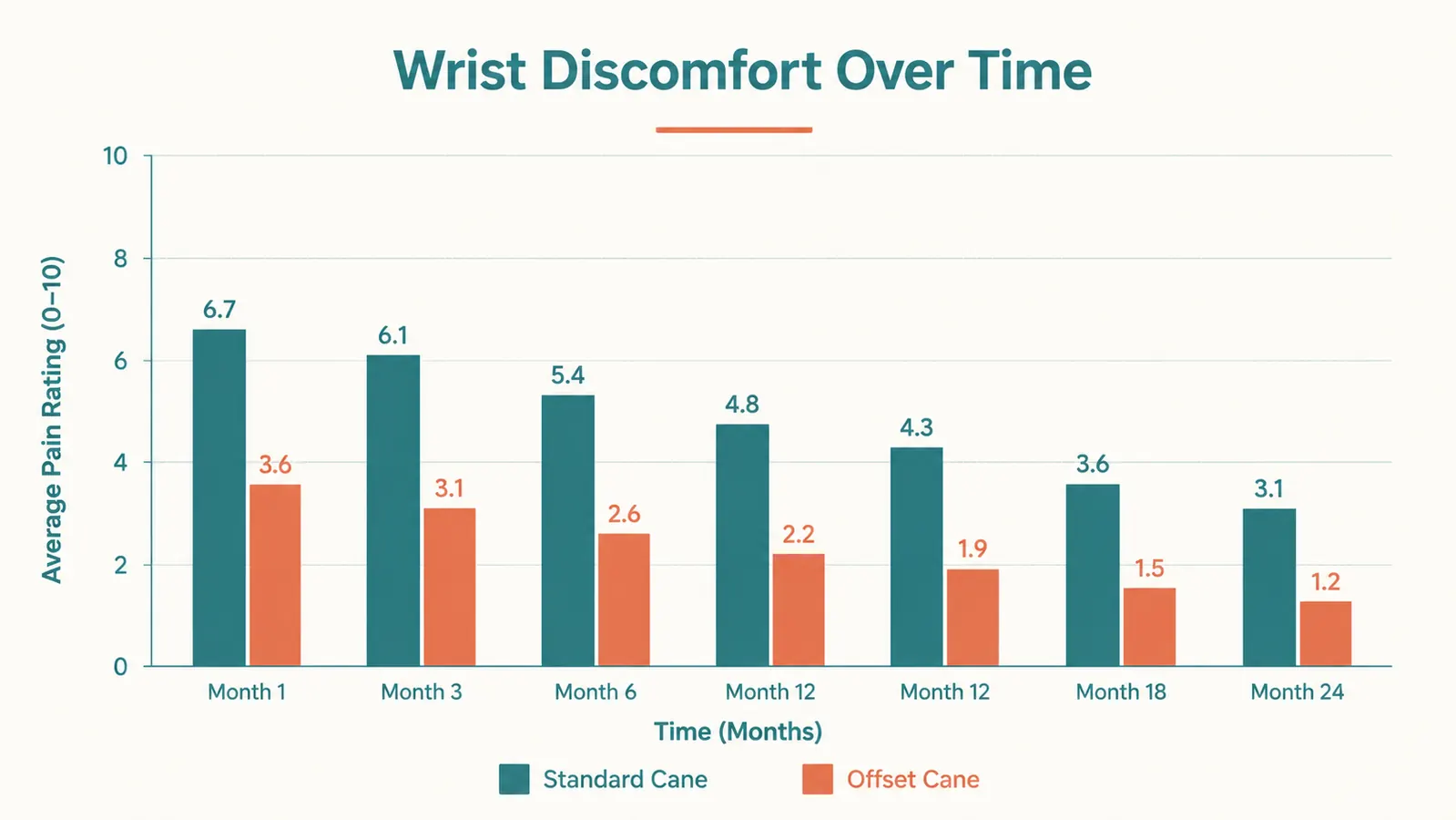
The offset handle positions the grip slightly forward of the shaft, which puts your wrist in a more neutral position. The load transfers more directly down through your arm. My PT demonstrated this with a grip strength dynamometer and a brief explanation of carpal mechanics that I mostly followed. What I understood clearly was the result: my wrist stopped aching within the first week. Two years in, I can walk for an hour with the NOVA and my wrist feels fine. That is not something I could say about any standard cane I tried.
My wrist stopped aching within the first week. Two years in, I can walk for an hour and my wrist feels fine. That is not something I could say about any cane I owned before.
The handle itself is contoured and firm. It is not a gel handle, which some people prefer, but I find the firm foam comfortable and it has not compressed noticeably in two years of daily use. My hand does not slip. In hot weather when my hands sweat slightly, I still have a secure grip. That matters to me more than softness.
Stability and the 500 lb Rating in Practice
I want to be plain about what a higher weight capacity actually means in practice. A 500 lb rated cane is not twice as safe as a 250 lb rated cane for someone who weighs 150 pounds. What it means is that the shaft, the joints, and the tip assembly are built to a more robust standard. The walls of the aluminum shaft are thicker. The push-button adjustment mechanism seats more firmly. The tip base is wider. All of those things translate to a cane that flexes less, makes less noise on pavement, and feels solid rather than hollow.
I have caught myself on this cane twice in two years. Not dramatic near-falls, but the kind of stumble where your weight shifts unexpectedly and you lean hard on the cane for a moment. Both times the cane held without any give or wobble. That is what a well-built cane is supposed to do, and this one did it. If you want to read about the difference between this cane and a lighter quad cane, I wrote about that in detail in my offset cane vs quad cane comparison.
What Wears Out and What Doesn't
The rubber tip is the one consumable part on this cane and it wears faster than I expected. I walk on pavement most days and I replaced the tip at the nine-month mark and again at eighteen months. Replacement tips are cheap and easy to find, and NOVA sells them directly, but you should know going in that you will need to replace the tip periodically. I recommend checking it every two or three months. When the rubber starts to show a flat spot or becomes visibly smooth, replace it. A worn tip on any cane is a slip hazard.
The wrist strap is not useful. It is the standard loop that came braided onto the handle and it is too short to sit comfortably over my wrist while I grip the handle. I removed it in the first week. This is a minor complaint and easy to ignore, but I mention it because some people rely on a wrist strap when crossing icy terrain or descending stairs and this one will not serve that purpose.
Everything else has held up. The height-adjustment button clicks the same way it did on day one. The shaft shows cosmetic scratches but no structural wear. The handle foam is unchanged. For a cane at this price point, that durability surprised me in the best way.
What I Liked
- Offset handle genuinely reduces wrist strain compared to a standard crook or T-handle cane
- 500 lb weight capacity means a sturdier shaft, tighter joints, and more confidence on uneven ground
- Height adjustment is fast and accurate, with one-inch increments and a secure push-button lock
- Lightweight enough at roughly one pound to carry all day without fatigue
- Handle grip is firm and non-slip, even in warm weather
- Holds up well over two-plus years of daily outdoor use
Where It Falls Short
- Rubber tip wears out faster than expected on pavement, plan to replace it roughly every nine months
- Wrist strap is too short to be useful and I removed mine in the first week
- Available in limited color choices, which matters to people who care about how their mobility aid looks

The Rain Test and Other Real-World Conditions
I live in central Florida and it rains most afternoons from June through September. I have walked in light rain with this cane and used it on wet tile entryways and wet concrete. A fresh rubber tip on the NOVA grips wet pavement well. The tip does not skate the way a worn tip would, and the shaft does not feel slippery when damp. I do not walk on ice, so I cannot speak to that condition, but for everyday wet surfaces in a warm climate this cane has been dependable.
One practical detail: the cane leans against walls and chairs when I am standing still. It does not have a folding design or a built-in stand, which means if you set it against a smooth surface it will slide. I have learned to hook the handle over a chair back or a shopping cart handle when I need my hands free. You can read more about the ergonomic reasons to choose an offset cane over other designs in my article on why an offset handle cane is easier on your wrist.

Who This Is For
The NOVA offset handle cane is the right choice if you use a cane every day and your wrist, hand, or forearm aches during or after walks. It is also a strong choice if you are heavier than average and want a cane with an engineering margin beyond your body weight. My daughter bought this for me after she saw me wincing from wrist pain on a basic aluminum cane, and it solved that problem within a week. If you are an adult child researching canes for a parent who uses one daily, this is the model I would point you toward first.
It is also worth noting that this cane is bariatric rated, which means it was designed with higher-weight users in mind from the start. The offset handle, the reinforced shaft, and the wider tip all reflect that engineering origin. Even if you are not in a higher weight category, you benefit from those design choices.
Who Should Skip It
If you need more than one point of contact with the ground, this cane is not the right tool. A quad cane has four feet and provides more lateral stability at rest, which some people need after a stroke or with certain balance conditions. If your physical therapist or doctor has recommended a quad cane specifically, follow that recommendation. I am speaking from my own experience as someone who needed stability support after falls but not a four-point base.
If you want a folding travel cane that fits in a bag, this is not it. The NOVA is a fixed-length cane (adjustable in height but not collapsible into sections). It does not fold. For everyday home-to-car-to-store use this is fine. For air travel or packing into a carry-on, you would want a folding model instead.
And if wrist pain is not your primary complaint and you are mainly looking for a decorative or occasional-use cane, you may not need the NOVA's heavier-duty construction. There are lighter and cheaper options that work fine for someone who only uses a cane occasionally. This cane earns its keep through daily use.
Two years in, this is still the only cane I trust on a wet sidewalk
The NOVA offset handle cane has held up through daily use, two rubber tip replacements, and two close calls where I needed it to catch my weight and it did. At this price point I am not sure you can do better.
Amazon Check Today's Price on Amazon →