

When my knee replacement came home with me, so did a folder of discharge instructions. Somewhere in the middle of that folder it said I should consider a "bed rail." I went online, typed in "bed rail for seniors," and immediately found myself lost. There were short ones and long ones. Ones with pockets and ones without. Full-length rails that ran the entire side of the mattress, and compact bars that barely cleared the edge. I did not know which was which, and I almost bought the wrong one. If I had, I would have been back to square one within a week.
My occupational therapist set me straight in about ten minutes. She said the two types serve completely different purposes, and buying the wrong one is not just wasteful, it can actually create a new hazard. What follows is what she told me, translated into plain language, plus my eight months of experience actually using the Medline bed assist bar at home. I will tell you when the assist bar is the right call, when a full-length rail might make more sense, and what to ask before you order either one.
| Bed Assist Bar (Medline) | Full-Length Bed Rail (Generic) | |
|---|---|---|
| Primary Use | Getting in and out of bed independently | Preventing a person from rolling out of bed |
| Handle Height | Sits above mattress surface, graspable standing | Runs along mattress edge, not optimized for standing push |
| Typical Length | 10 to 16 inches | 36 to 60 inches |
| Installation | Slides between mattress and box spring, no tools | Usually requires frame attachment or strap system |
| Storage | Many include a pocket for phone, glasses, remote | Rarely includes storage |
| Weight | Around 4 to 6 lbs | 5 to 10 lbs or more |
| Who It Is For | Seniors getting up independently, post-surgery recovery | Seniors with dementia, neurological conditions, fall-out-of-bed risk |
| Price Range | Around $30 to $50 | Around $40 to $90 |
| Weight Capacity | Up to 300 lbs (Medline model) | Varies widely by manufacturer |
Where the Medline Bed Assist Bar Wins
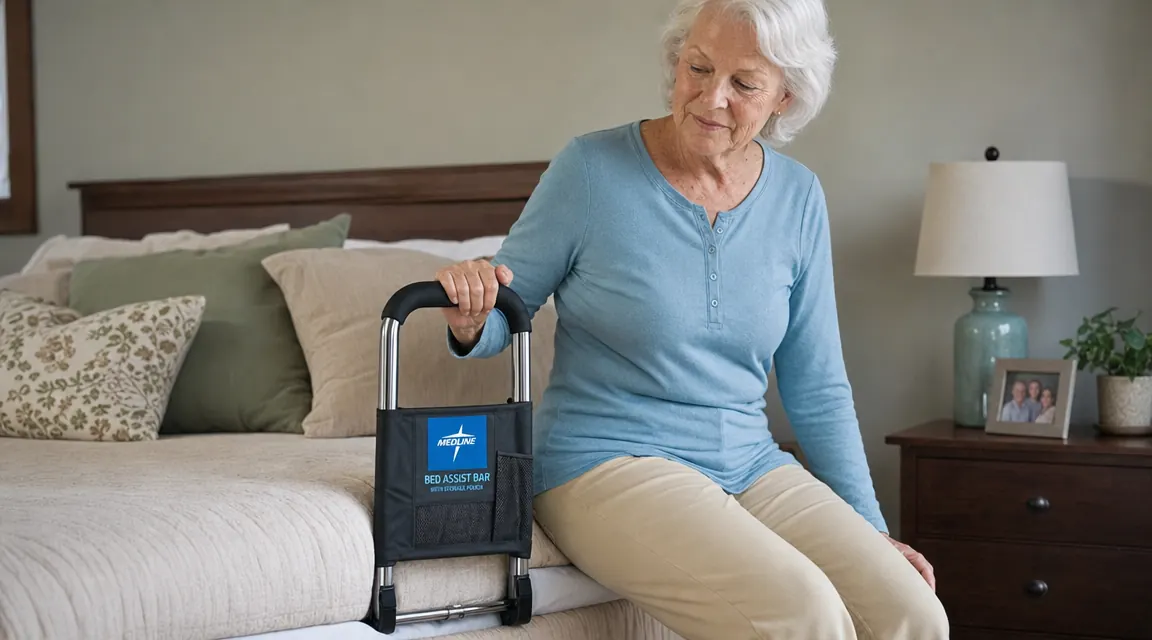
The short version: if you need help getting your body from lying down to sitting upright, and then from sitting to standing, the Medline bed assist bar is built for exactly that. After my knee replacement, the hardest part of every morning was that first two-foot journey from flat on my back to sitting on the edge of the bed. My knee could not generate the torque. My arms were not strong enough on their own. The assist bar gave me something solid to push and pull against at exactly the right height.
The bar slots between your mattress and box spring with no tools, which matters when you are doing this yourself, possibly the day after you get home from the hospital. Once it is seated, it does not wobble. The Medline model holds up to 300 pounds, which covers the vast majority of users. The handle sits at the right height for someone sitting on the edge of the bed, which is very different from what you get with a full-length rail. The storage pocket on the side has turned out to be one of the most genuinely useful features I did not expect. My phone, my glasses, and a tissue live there every night. I do not have to fumble around on the nightstand at 3am anymore.
The Medline also works well for adult children buying for a parent who lives alone. If your mother had a fall or just had surgery and you are not there overnight, the assist bar gives her a reliable anchor to get out of bed without waiting for someone to come help. That independence matters. My daughter bought mine, and I think it was one of the more useful gifts she has ever given me. You can see current pricing and availability at Amazon's current listing for the Medline Bed Assist Bar.
Where the Full-Length Bed Rail Wins
A full-length rail is a different tool for a different problem. My OT was very direct about this. Full-length rails were originally designed for hospital environments where a patient might roll out of bed, particularly someone with dementia, a neurological condition, or a sedative-heavy medication schedule. The rail runs along most of the mattress length and keeps the person contained on the sleeping surface. It is a protective barrier, not a mobility aid.
If your parent is getting out of bed overnight without knowing they are doing it, a full-length rail can be a reasonable way to reduce that risk. If your parent has significant balance and strength issues and is not trying to get out of bed independently anyway, a full-length rail might work alongside caregiver assistance. The longer rail also gives a mobile senior more surface to hold along as they reposition in bed, though that is secondary to its containment purpose. If the situation is "Mom could roll out of bed" rather than "Mom cannot get out of bed to start her day," then the full-length rail fits better.
If the goal is getting out of bed on her own, this is the one your OT would point to.
The Medline bed assist bar has 15,000-plus reviews on Amazon and installs in under five minutes with no tools. It is the most common recommendation I see from physical and occupational therapists for post-surgery recovery and general nighttime independence.
Amazon Check Today's Price on Amazon →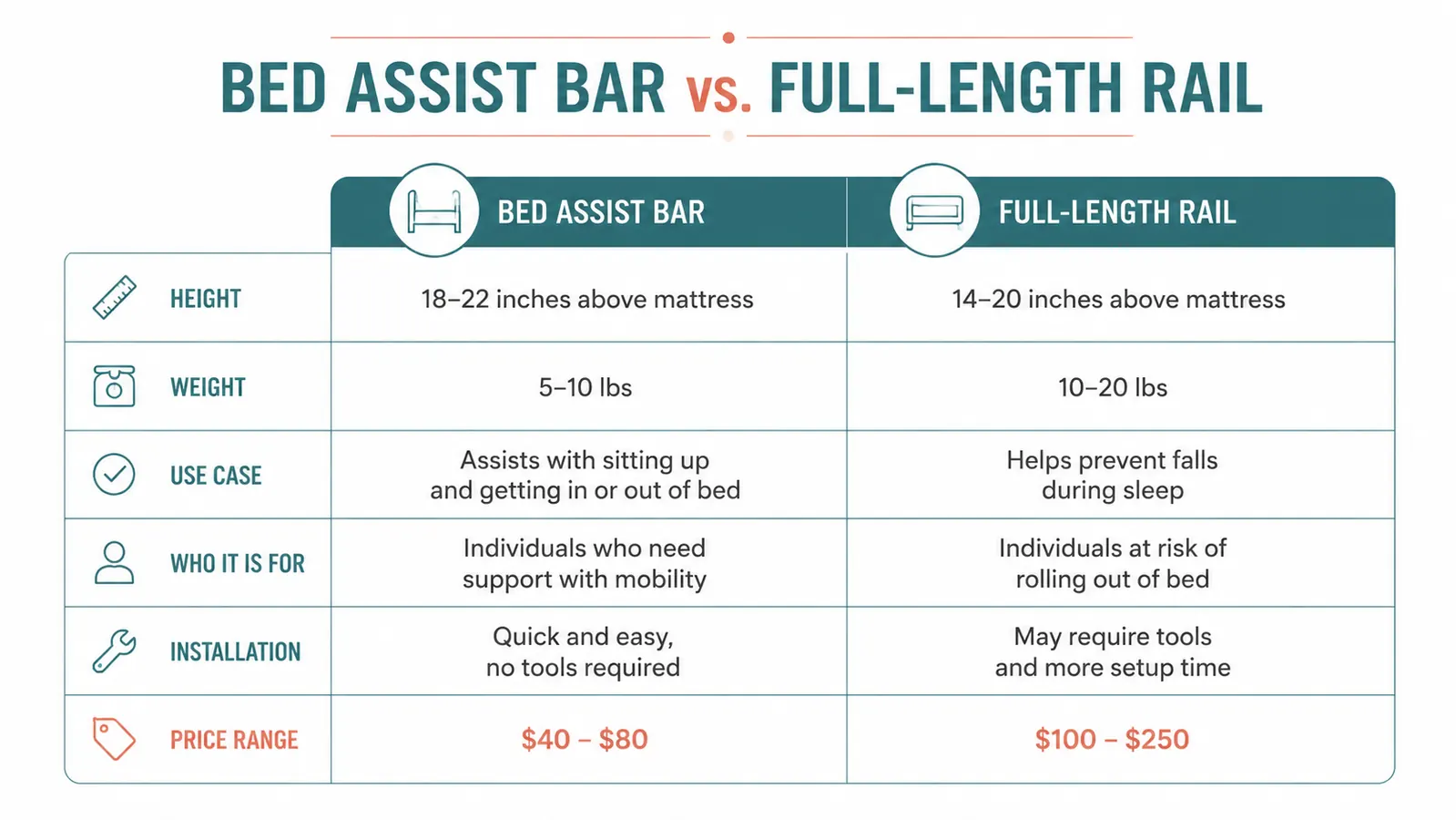
The Safety Issue Nobody Mentions
My OT brought this up without me asking, and I think it is important enough to repeat here. Full-length bed rails have a documented entrapment risk. The gap between the rail and the mattress, or between the rail and the headboard, can trap a person's head, neck, or chest if they roll against it during sleep. The FDA has issued warnings about this. It does not mean full-length rails are never appropriate, but it does mean they are not a casual purchase. If you are considering one for a parent or for yourself, talk to a doctor, OT, or home health nurse first.
The bed assist bar does not carry this risk in the same way because of its short length. There is no gap running along the side of the mattress. The handle is too short to create a space large enough for entrapment. That is one more reason my OT leaned toward the assist bar for most of the seniors she works with who are mobile and recovering, rather than bedridden.
She said it plainly: if your parent can get out of bed on their own, get the assist bar. If your parent cannot get out of bed and needs to be kept safe on the mattress, talk to a doctor before you order anything.
Who Should Buy Which
Here is the decision tree I wish I had when I was standing in my kitchen trying to figure this out. If the problem is that you (or your parent) struggles to get from lying down to sitting up, or from sitting to standing, and you are still mobile enough to want to do it without help, the Medline bed assist bar is almost certainly what you want. It is under $35 at most times, installs without tools, and works on the vast majority of standard mattresses. I have had mine for eight months and the only thing I would change is buying it sooner. My full write-up is in my long-term Medline bed assist bar review if you want to read about specific day-to-day use before you decide.
If the problem is that a loved one is at risk of rolling out of bed overnight, is confused at night, or is bedridden and needs to be repositioned safely, a full-length rail might be worth discussing with their care team. But please do talk to someone first, specifically about mattress fit and gap size, given the entrapment issue. That is not a reason to avoid full-length rails entirely, but it is a reason to buy one with guidance rather than alone at 11pm on your laptop.
One more thing worth knowing: the two products can coexist. A few people I know use an assist bar on one side of the bed and a full-length bumper on the other side. The assist bar is on the side they get up from, the bumper is on the wall side to prevent rolling. That combination works well for people who are mobile on one side but want a soft boundary on the other. It is not the most common setup, but it is worth knowing it is an option.

Practical Things to Check Before You Order
Mattress thickness matters for the assist bar. The Medline fits mattresses between 7 and 16 inches thick. If you have one of those very thick pillow-top mattresses, measure first. The bar slides between the mattress and the box spring, so you also need a box spring or platform with a solid edge. If your bed frame has wheels, check whether locking wheels are available, because any movement in the frame will transfer to the bar and reduce stability.
For full-length rails, the most important check is the gap between the rail and the mattress and the gap between the rail and the headboard or footboard. The FDA's guidance suggests gaps should be no wider than about 2.5 inches to reduce entrapment risk. Ask the manufacturer for specific measurements, because the listing photos will not tell you what you need to know.
Weight capacity is the other thing to confirm. The Medline holds 300 pounds. Most full-length rails list a weight capacity but it can vary significantly. If there is any question, go to the manufacturer's website and look at the actual spec sheet rather than relying on the listing description.
My Bottom Line
I have been using the Medline bed assist bar every single day since I came home from my knee surgery. It is not glamorous. It is a chrome handle and a metal sleeve that tucks under my mattress. But it let me get out of bed at 3am without waking my husband, without calling for help, and without lying there for ten minutes working up the nerve to try. For most seniors recovering from surgery or managing joint pain, that kind of independence is worth more than almost anything else you can buy for the bedroom. I also wrote up everything I have learned about getting out of bed safely with bad knees in my article on how to get out of bed safely with bad knees, which covers the technique my PT taught me alongside the equipment.
A full-length rail has its place. It is just not the place most people picture when they type "bed rail" into a search engine. Know which problem you are actually trying to solve before you order, and you will end up with something that actually helps.
Eight months later, I would buy this exact bar again without hesitating.
The Medline bed assist bar is what my occupational therapist recommended and what I have used every night since my knee replacement. It fits most standard mattresses, installs without tools, and holds 300 lbs. The storage pocket is genuinely useful. If your goal is getting out of bed independently, this is the product most OTs point to first.
Amazon Check Today's Price on Amazon →