

Before I ordered the Medline Bed Assist Bar, I did something I usually skip: I sorted the reviews by lowest rating and read every one-star complaint I could find. I had already broken a wrist in one fall and a leg in another. I was not interested in buying something that would let me down at 2am in the dark. I wanted to know exactly what had gone wrong for other people before I trusted this product with my safety.
That was eight months ago. I've used it every night since. Some of those one-star complaints turned out to be completely valid warnings. Others were user error that nobody at Medline bothers to clarify on the product page. And a few were people who bought the wrong product for their situation entirely. I'm going to walk you through all of it, because if you're reading this you probably need to get this decision right.
The Quick Verdict
Genuinely useful bed rail at a price that's hard to argue with, but only if your bed is compatible. The installation failures and wobble complaints in the one-star reviews are real and preventable. Know your bed setup before you buy.
Amazon Check Today's Price →If your bed has a box spring and you're struggling to get up at night, this is probably the fix. Read the compatibility notes below first.
The Medline Bed Assist Bar installs in minutes with no tools, holds up to 300 lbs, and has over 15,000 reviews at 4.6 stars. But it requires a gap between mattress and frame. Check that your bed qualifies before ordering.
Amazon Check Today's Price on Amazon →How I've Actually Used It (Eight Months of Nightly Reality)
My bed is a queen on a traditional box spring, mattress thickness right around 11 inches. I installed the bar myself in about eight minutes while my husband watched and offered to take over every thirty seconds. I didn't need his help. The bracket slides between the mattress and the box spring, and once it's in position you lower the mattress back onto it. The bar sticks up from the side of the bed at a slight forward angle that makes it natural to grab when you're transitioning from lying down to sitting.
What I actually use it for: I reach for it in the middle of the night when I need to get up and have that half-asleep moment where my legs forget what they're supposed to do. I use it to lower myself down when I go to bed so I don't drop the last few inches. And I use it as a steadying point while I get my slippers on, which sounds minor but is genuinely one of the moments when people fall. Eight months, twice a night minimum, zero incidents. That's the review in one sentence.

The One-Star Complaint I Take Most Seriously: Platform Beds
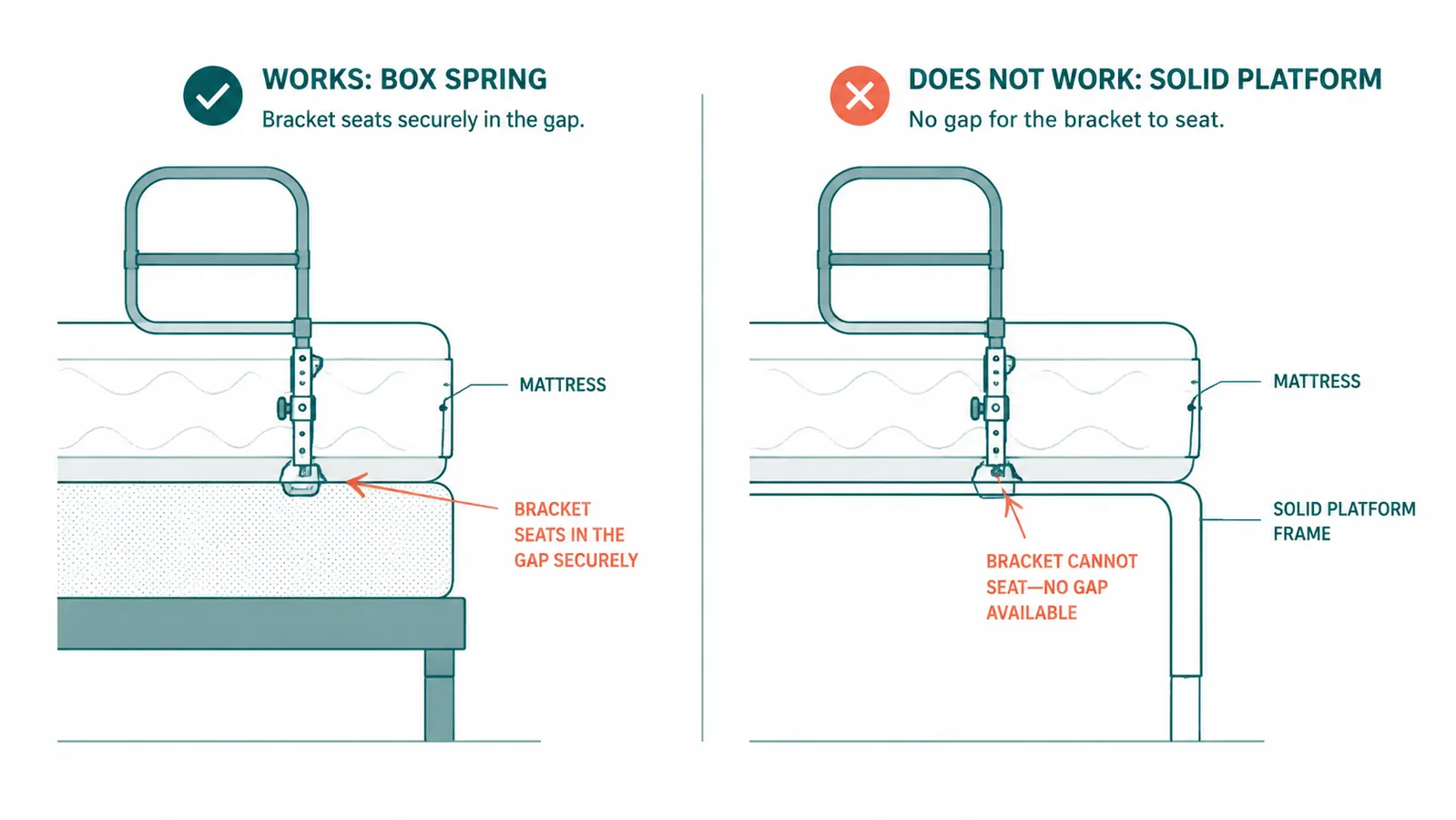
The single most common legitimate complaint I found was this: the bar doesn't work on solid platform beds. And this is not a small problem, because modern beds with platform frames are everywhere. If your mattress sits directly on a solid platform surface with no gap, the bracket has nothing to grip and the bar will not stay put. Some reviewers described it sliding right out when they grabbed it. That is a safety failure, not a product defect, but it should be printed in large type on the packaging and it isn't.
The bar needs at least two inches of gap between the underside of your mattress and whatever surface it rests on. A traditional box spring gives you that gap automatically. A slatted platform frame may give you enough, depending on slat spacing and mattress thickness. A solid platform frame gives you nothing. Before you order, get down and look at your bed from the side. If you can slide your hand between the mattress and the frame, you probably have enough clearance. If the mattress sits flush on a solid surface, this is not your product. Look at freestanding bed rails with weighted bases instead.
Adjustable bases are another category to think about carefully. The bracket is designed to sit stationary. If your base tilts or adjusts, the bracket may shift position over time. I've seen a few reviewers report this. My base doesn't adjust, so I can't speak to it from experience, but I'd be cautious.
The Wobble Complaint: What It Actually Means
After the platform bed issue, the second most common complaint is wobbling. People write that the bar shakes side to side when they grab it and doesn't feel safe. I want to explain what's happening there, because my bar does not wobble at all and never has.
The bar's stability comes from one thing: the weight of the mattress pressing down on the bracket. If the bracket is not fully seated under the mattress, if only part of it is caught, or if the mattress is too light to hold it down firmly, you will get wobble. The fix is almost always reinstallation. Pull the mattress fully off the frame, slide the bracket all the way in so the entire flat plate is under the mattress, then lower the mattress back down squarely. Shake the bar hard before you trust it with your weight. If it still wobbles after that, your mattress may be too light, too thick, or your frame may not be providing enough clamping pressure. But in most cases, proper installation stops the wobble.
My husband did a serious stability check when we first put ours in. He pushed it sideways, pulled it toward him, shook it front and back. Nothing moved. That's the bar working as designed. If yours moves after proper installation, contact Medline before assuming the product is defective.
The bar's stability comes from one thing: the weight of the mattress pressing down on the bracket. If the bracket isn't fully seated, you get wobble. Proper installation almost always fixes it.
The Height Problem Nobody Mentions Until They're Already Annoyed
Here is something the product listing doesn't make especially clear: the bar height above the mattress surface is fixed. You cannot raise or lower it. Once the bracket is in position, the grip sits where it sits. For most people on a standard queen or king with a normal mattress height, this works out fine. For me, with a 26-inch total bed height from floor to mattress top, the grip lands right at hip height when I'm sitting on the edge. That's ideal. I don't have to reach down or strain upward to grab it.
But if your mattress is unusually tall, say a thick pillow-top that brings your sleeping surface up to 30 or 32 inches from the floor, the grip may end up lower than your hip when seated. That's a less useful angle. And if you have a very low platform bed where the mattress surface is only 18 or 20 inches high, the bar may end up higher than your hip when seated, which is also awkward. The bar fits a range of standard bed heights. It doesn't fit every bed. Check your own setup before assuming it will work.
You can adjust the bracket position slightly by sliding it forward or back within the mattress gap, which changes the angle the bar presents. I played with this during installation and found a position that felt natural. Give yourself ten minutes to experiment rather than just dropping it in the default position.
What the 300-Pound Rating Actually Tells You
The bar is rated to 300 lbs. Most reviewers who comment on weight capacity say it held fine even for heavier users. But there's something the rating doesn't tell you: how you use the bar matters as much as how much you weigh. If you grab the bar and hang all your body weight straight down on it, you're putting shear stress on the bracket joint. If you use it to push yourself from sitting to standing, the force is mostly lateral, which is a more stable load for this design.
My physical therapist at Magnolia Orthopedics told me this early on. The bar is not a trapeze. You're not meant to hang from it. You use it to redistribute some of your body weight through your arms while you transition, reducing the load on your knees, hips, or back. That motion is a push, not a hang. If someone is going to hang their full weight straight down on it because they cannot push themselves up at all, they may need a ceiling-mounted trapeze bar or a hospital-grade bed rail with a sturdier anchor system.
The Storage Pocket: Surprisingly Useful, One Honest Caveat
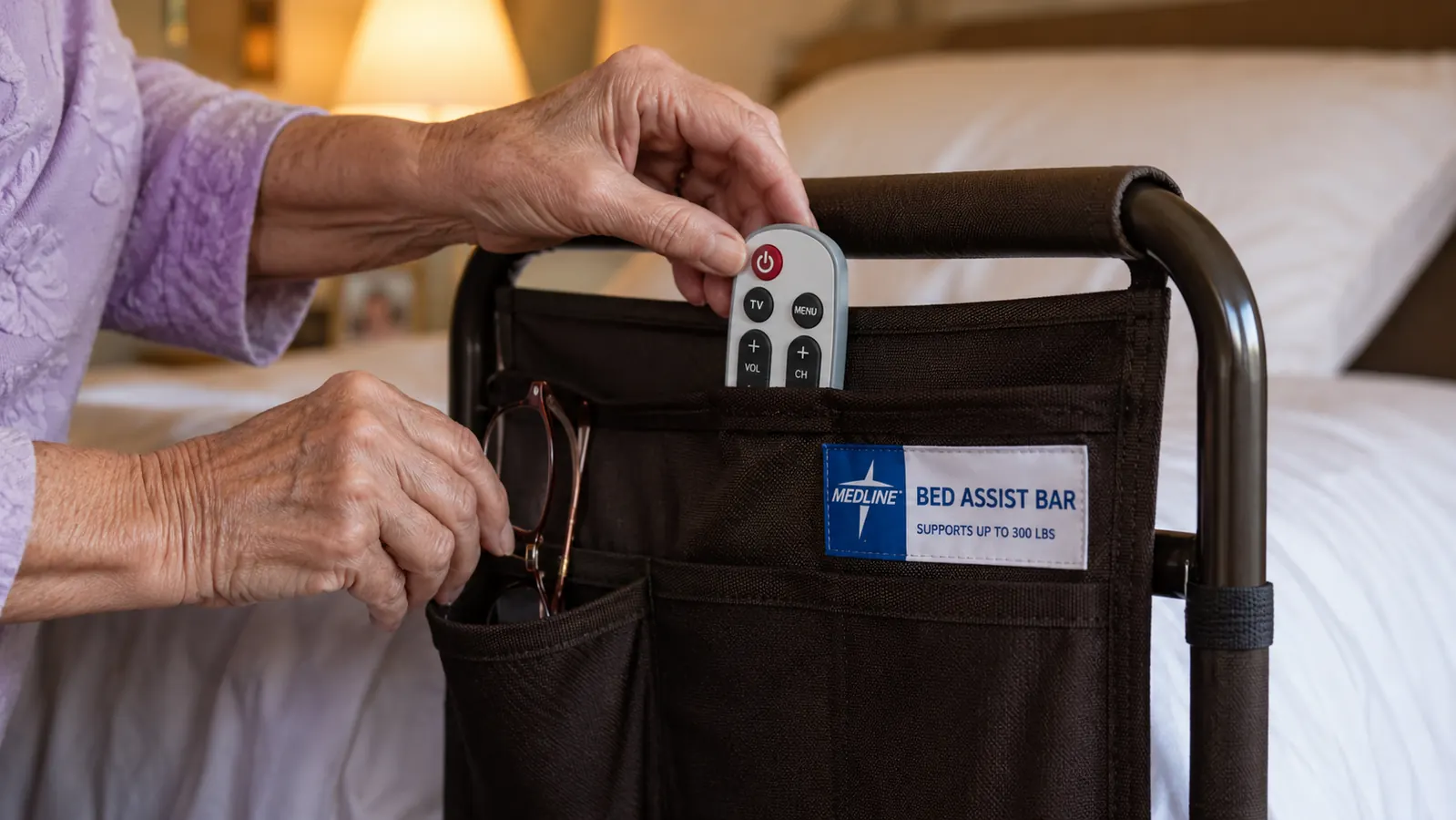
I was prepared to ignore the storage pocket. It seemed like the kind of feature that sounds nice but turns out to be awkward to use and holds things you then forget about. I was wrong about that. The pocket sits at roughly elbow height when I'm sitting on the edge of the bed. I drop my reading glasses in there before I lie down and they're right there in the morning without me having to lean over to the nightstand. My television remote lives there now too, because I kept knocking it off the nightstand trying to find it in the dark.
The honest caveat: the pocket opening faces away from you when you're lying in bed. So if you want to retrieve something while lying down, you have to reach behind the bar. That's a mild annoyance. But if you use it as a parking spot for things you want when you first sit up, it works well. The zipper has held through eight months of daily use, which I cannot say for every fabric product in my house.
What I Found in the One-Star Reviews That Nobody Warned Me About
A few patterns stood out from the low-rated reviews that are worth knowing going in. First, several reviewers bought this expecting it to prevent a sleeping person from rolling out of bed at night. This bar does not do that. It is a sit-to-stand assist. The bar is 18 inches tall above the mattress at most. A person shifting in their sleep can go right over or around it. If your concern is nighttime rolling, you need a full-length bed rail, and I explain that distinction in detail in my comparison of bed assist bars versus full-length bed rails. These are different products solving different problems.
Second, a handful of reviewers reported that the bar arrived with a bent bracket or a handle that wasn't fully attached. That's a manufacturing quality-control issue that happens with any mass-produced product. If yours arrives damaged, Amazon's return process for this item has been straightforward based on what I've read. Don't fight with a damaged product. Return it.
Third, and this one genuinely surprised me: a few reviewers were upset that the bar didn't help with getting up from a low couch or chair. It's a bed rail. It is designed for bed use. I mention this only because it tells you something about the variety of expectations people bring to a product review. Filter accordingly.
What I Liked
- Installs in under ten minutes, no tools, no drilling into walls or floors
- Stays absolutely firm on a standard box spring setup once properly seated
- Foam-padded handle is comfortable for arthritic hands after months of daily use
- Storage pocket is genuinely useful rather than decorative
- Price point makes it accessible without a long deliberation
- Reads as furniture-adjacent rather than institutional medical equipment
Where It Falls Short
- Completely incompatible with solid platform beds and some low-profile frames
- Bar height is fixed, no adjustment for high pillow-tops or unusually low beds
- Wobble is a real problem if installation isn't done carefully and fully
- Not designed to prevent nighttime rolling, wrong product if that's your need
- Weight rating assumes correct use (pushing, not hanging), not spelled out clearly
- Storage pocket faces away from lying position, requiring a small reach behind the bar

Who This Is For
The Medline Bed Assist Bar is the right purchase if you have a traditional box spring bed or a slatted frame with enough gap, you're recovering from surgery or managing a condition that makes the sit-to-stand bed transition painful or unsteady, and you want a tool-free installation that doesn't require a contractor or a handyman. It also makes sense if you're an adult child who wants to add one concrete safety improvement to your parent's bedroom without triggering a fight about independence. The bar is subtle. It looks like a piece of furniture. Most guests don't even ask about it.
It works especially well for the gap between sitting up and standing, that three-to-five second window when you're upright but not yet oriented and your balance systems are still coming online. That's when falls happen. The bar gives you something to hold onto through that window. You can read more about why that transition is specifically dangerous in my piece on 10 reasons a bed rail prevents nighttime falls.
Who Should Skip It
If your parent or you have a solid platform bed with no gap between mattress and frame, do not order this. Full stop. It will not seat safely and it should not be trusted. Look for a freestanding model with a weighted base, or a bed safety rail designed specifically for platform frames. Spending thirty dollars on a product that won't work for your bed is not a bargain.
If the goal is preventing a person from rolling out of bed at night, this is also not the right product. An 18-inch assist bar doesn't protect a sleeping person who shifts toward the edge. A full-length bedrail or a bolster-style bed bumper addresses that need. And if the person using the bed has very limited grip strength or cannot push themselves up at all from a seated position, they may need something with more mechanical advantage, like a trapeze bar that attaches to the ceiling or bed frame and allows the person to use both arms and their upper body weight to pull rather than push.
If none of those exceptions apply to your situation, and your bed is compatible, I think this is an easy call. I've used mine every night for eight months and it has done exactly what I needed it to do.
If your bed has a box spring and you're not sure whether getting up at night is becoming a risk, don't wait for a fall to find out.
The Medline Bed Assist Bar is one of the few genuinely affordable safety improvements you can make to a bedroom in under ten minutes. Over 15,000 Amazon ratings at 4.6 stars. Check today's price and verify it ships quickly before you need it.
Amazon Check Today's Price on Amazon →