

After my second fall, I sat on the floor of my kitchen for what felt like a very long time before I tried to get up. My leg was fine that time, just badly bruised, but my confidence was not. I'd broken my wrist in the first fall, eighteen months earlier. Now I was starting to wonder if the floor was just going to keep winning.
The thing nobody warned me about is the fear that sets in after a fall. It's not dramatic. It's quiet. You stop going to the farmer's market because the parking lot is uneven. You stop walking to the mailbox after a rain. You start shuffling instead of stepping. And that shuffle, my physical therapist told me, is exactly what puts you at higher risk for the next fall. Inactivity makes your balance worse. Not better.
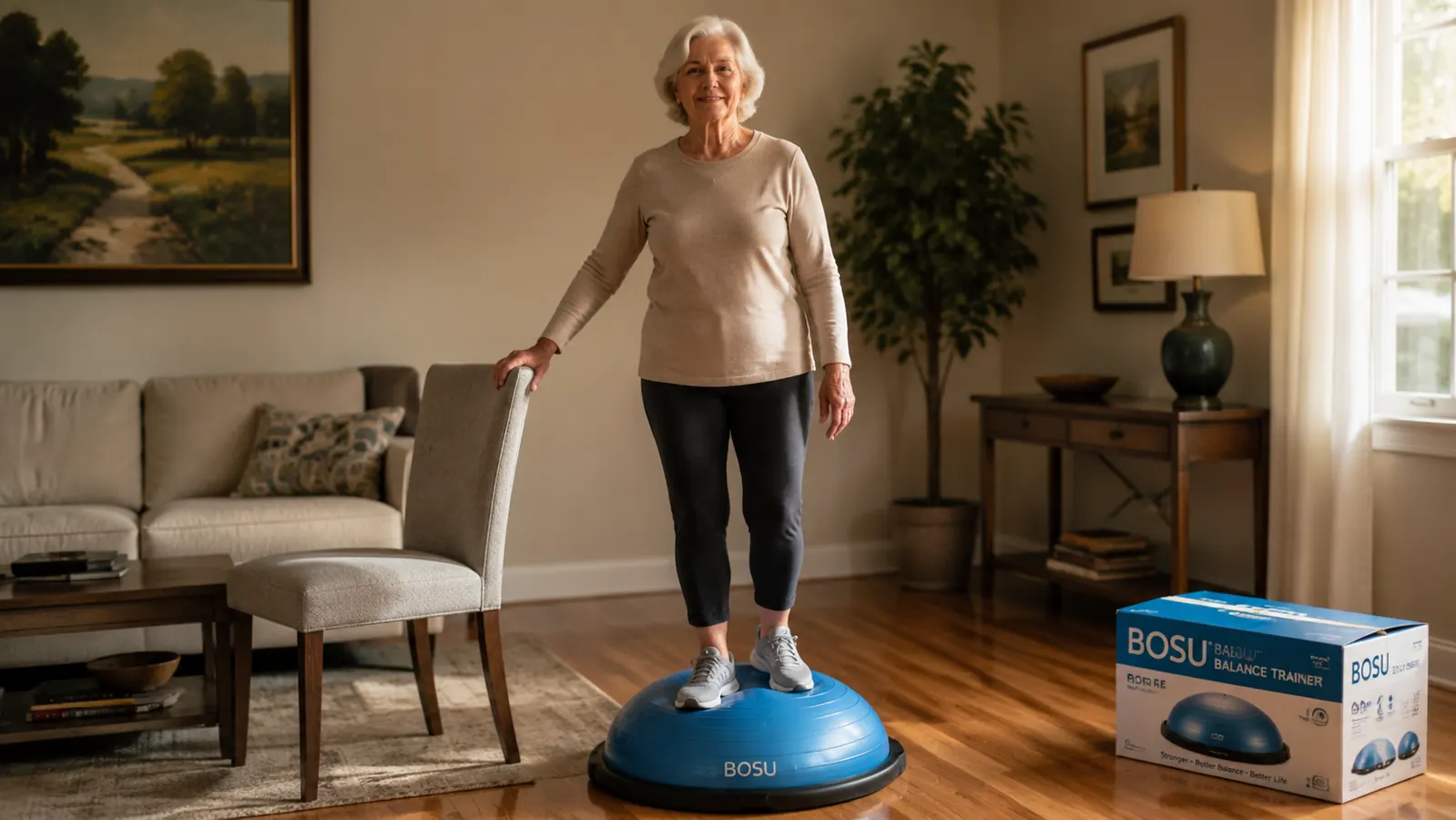
The balance trainer my PT recommended when I was ready to move past basic exercises
The BOSU Balance Trainer (4.5 stars, 10,000+ reviews) is what my PT introduced in Phase 4 of my recovery plan. It's not a beginner's first day tool, but when you're ready for it, it's genuinely effective. I've been using mine for six months.
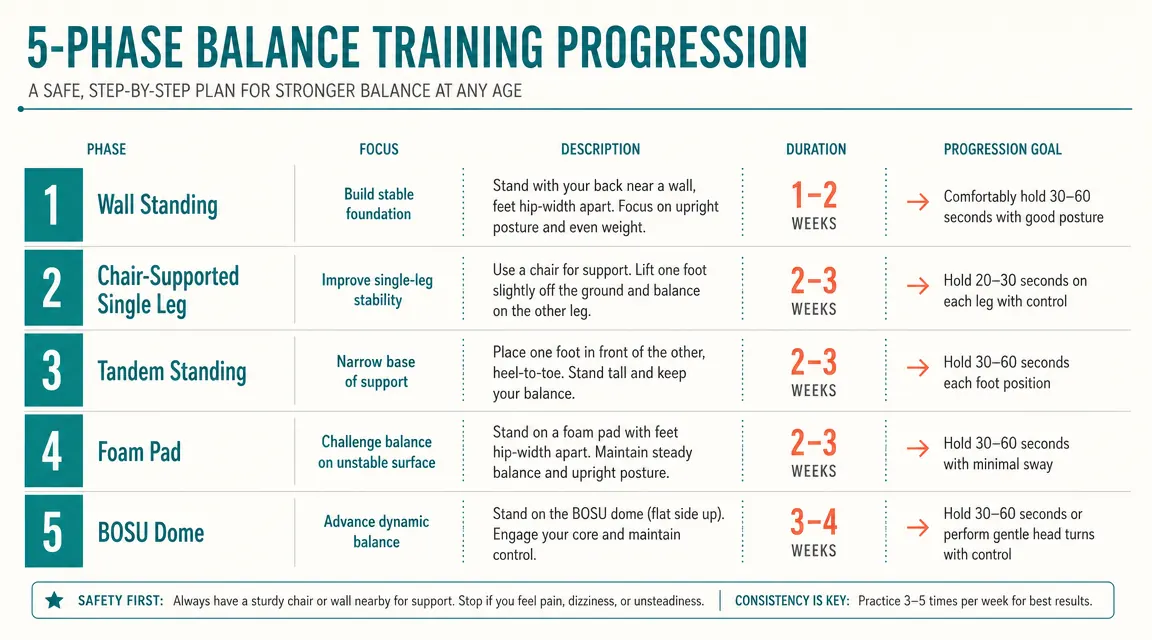
Amazon Check Today's Price on Amazon →My physical therapist, a woman named Deborah who has about zero tolerance for excuses and genuine warmth in equal measure, gave me a progression plan on my second appointment. She wrote it out by hand on a notepad sheet and told me to follow it exactly, in order, without skipping ahead. I've rewritten it here as clearly as I can, in the order she gave it to me, because I think it might help someone else who's sitting on their metaphorical kitchen floor right now wondering where to even begin.
One important note before we start: I am not a medical professional. I'm a 74-year-old woman who fell twice and worked her way back. Please check with your own doctor or physical therapist before starting any new exercise program, especially if you have an injury, cardiovascular condition, or osteoporosis. What worked for me may not be right for your specific situation.
Step 1: Start With Wall-Supported Standing (Weeks 1-2)
Deborah's first instruction was the simplest thing I'd ever been told to do for exercise, and I still felt nervous doing it: stand next to the wall, close enough to touch it, and simply stand. Both feet flat. Eyes open. For 30 seconds at a time.
That's it. That was the whole exercise. And if you've fallen recently, you may discover, like I did, that 30 seconds of standing without distracting yourself feels unfamiliar. Your brain has been avoiding the sensation of trusting your own body. This exercise starts rebuilding that trust. Do it three times a day, wherever you happen to be: at the kitchen counter, next to the bathroom vanity, beside your bed. The wall is not a crutch. It is a confidence-builder.
After a few days, Deborah had me progress to a simple weight shift: standing near the wall, slowly shift your weight from your left foot to your right foot and back, 10 times. Pause when you feel wobble. Don't push through it. The goal is awareness, not performance. You are relearning how your body communicates with your brain about where you are in space. That communication system is called proprioception, and falls damage it. These exercises start repairing it.
Step 2: Chair-Supported Single-Leg Balance (Weeks 2-4)
Once I could do the weight-shift exercise without flinching, Deborah introduced single-leg standing with a chair directly in front of me. Not to sit down, to grip the back of if needed. Stand on one foot, lift the other just an inch or two off the floor, and hold. She started me at 10 seconds. The goal over two weeks was to reach 30 seconds on each side.
This sounds trivial. It is not trivial. On my right side (the side opposite my fall injury), I could barely hold 8 seconds the first time without my standing leg shaking. If that's you, do not be embarrassed and do not skip ahead. The wobble is information. Deborah told me to look at a fixed point on the wall rather than at the floor, looking down shifts your center of gravity forward and makes balance harder. She also told me to breathe, which I had apparently stopped doing.
If you're doing this at home for a parent, set up a sturdy chair with a non-tip base in front of them, and stand nearby the first few times. Not hovering, just present. The psychological difference between having someone nearby and exercising completely alone matters more than most people realize when fear of falling is still fresh.
Step 3: Tandem Standing and Tandem Walking (Weeks 4-6)
Tandem standing means standing with one foot directly in front of the other, heel to toe, like you're on a tightrope. It is harder than it looks, even for people who have never fallen. Again, position yourself beside a counter or wall. Start with 15 seconds and work toward 45 seconds. Then try tandem walking: taking small slow steps heel-to-toe down a hallway, one hand trailing along the wall. Eight to ten steps and back.
This exercise specifically trains the narrow base of support that's relevant to everyday situations: walking through a doorway, navigating a crowded grocery aisle, stepping sideways in the kitchen. The reason seniors fall in these moments isn't weakness, usually. It's that the balance system doesn't adjust fast enough to a narrow or unexpected base. Tandem practice speeds up that adjustment.
Deborah told me something I think about all the time: 'The goal isn't to never wobble. The goal is to wobble and recover before you fall. That's what training builds.'
Step 4: Introduce an Unstable Surface, Start With a Foam Pad (Weeks 6-8)
This is where things start to feel like actual exercise rather than standing practice. Deborah had me step onto a basic foam balance pad, still near the counter, and simply stand. The foam forces your foot, ankle, and lower leg to make dozens of tiny micro-corrections per second. It is exhausting in a way that flat-ground standing simply is not, and the exhaustion is evidence that your nervous system is working.
You can buy a basic foam balance pad for under $25. It is a perfectly adequate tool for this phase. If you're buying for a parent, look for one that is dense enough to be firm underfoot, softer foam is harder to balance on and is more appropriate for later stages. Deborah's rule was: if you can't stand on it for 30 seconds without significant shaking, it is the right foam pad to keep using. When 30 seconds feels easy, you're ready to move on.
Step 5: Graduate to the BOSU Balance Trainer (Weeks 8-12 and Beyond)
The BOSU Balance Trainer is a half-sphere with a flat rigid platform on one side and an inflatable dome on the other. For fall prevention work, you use it dome-side-up and stand on the dome. The dome is firmer and more forgiving than a foam pad, but because it has give and a curved surface, it challenges your balance in a more dynamic way. It mimics the unpredictable surfaces that actually cause falls: a soft lawn, a slightly uneven sidewalk, thick carpet.
I was skeptical. It costs around $150, which is not nothing, and I had done fine with the foam pad. But Deborah explained that the BOSU has a calibrated inflation level, which means the resistance is consistent every time. The foam pad I was using had started to compress unevenly, which was actually reducing its effectiveness. The BOSU comes with a pump and guided exercise materials, which helped me move beyond just standing into simple movements: slight knee bends, weight shifts, and eventually slow marching in place.
Important note on safety: always have a sturdy chair or counter arm's reach away when you first use a BOSU. The first few sessions will feel genuinely unstable. That's the point, but you want a recovery option nearby. After about three sessions, most people find they can stand on it without reaching for support. I was at about four sessions before that happened for me.
At 4.5 stars across more than 10,000 reviews, the BOSU is one of the more consistently rated pieces of balance equipment on Amazon. The most common complaints are about the pump and the included instructions, which are minimal. Deborah gave me a separate exercise sheet; I've summarized the core moves above. The equipment itself is well-made and mine has held up well over six months of regular use at 74 years old.
What Else Helps
Balance training is the foundation, but Deborah also gave me three supporting habits that she said matter as much as the exercises themselves. First: footwear. Bare feet or grippy socks at home, never slippery socks, and shoes with a low heel and firm sole when going out. The shoes I'd been wearing had a slightly cushioned sole that, it turned out, was reducing my ground feedback. I switched to a low-profile walking shoe and noticed a difference within days.
Second: lighting. Most nighttime falls in seniors happen between the bedroom and the bathroom in the dark. A simple plug-in night light, or even a phone flashlight habit, removes a significant hazard with zero effort. Third: knowing when you are most tired. My balance is measurably worse after 8 pm and after any meal when I'm slightly drowsy. Deborah told me to do my balance exercises in the morning, when my system is freshest, and to be extra cautious during my vulnerable windows. That's not giving up. That's strategy.
If you want to go deeper on the case for balance training specifically, I've written about it in 10 Reasons Balance Training Reduces Fall Risk for Seniors. And if you're evaluating whether the BOSU is worth the price, my six-month BOSU review covers what actually changed for me over time and what I'd tell you if I were recommending it to a close friend.
When you're ready for Phase 5, the BOSU is what my PT recommends, and what I've been using for six months
The BOSU Balance Trainer isn't where you start, it's where you graduate to after building a foundation. If you're working through the five steps above, bookmark this for when you get to Phase 4. It is a real tool that produces real results, and at 4.5 stars across 10,000+ reviews, it's held up well for a lot of people in situations much like mine.
Amazon Check Today's Price on Amazon →