
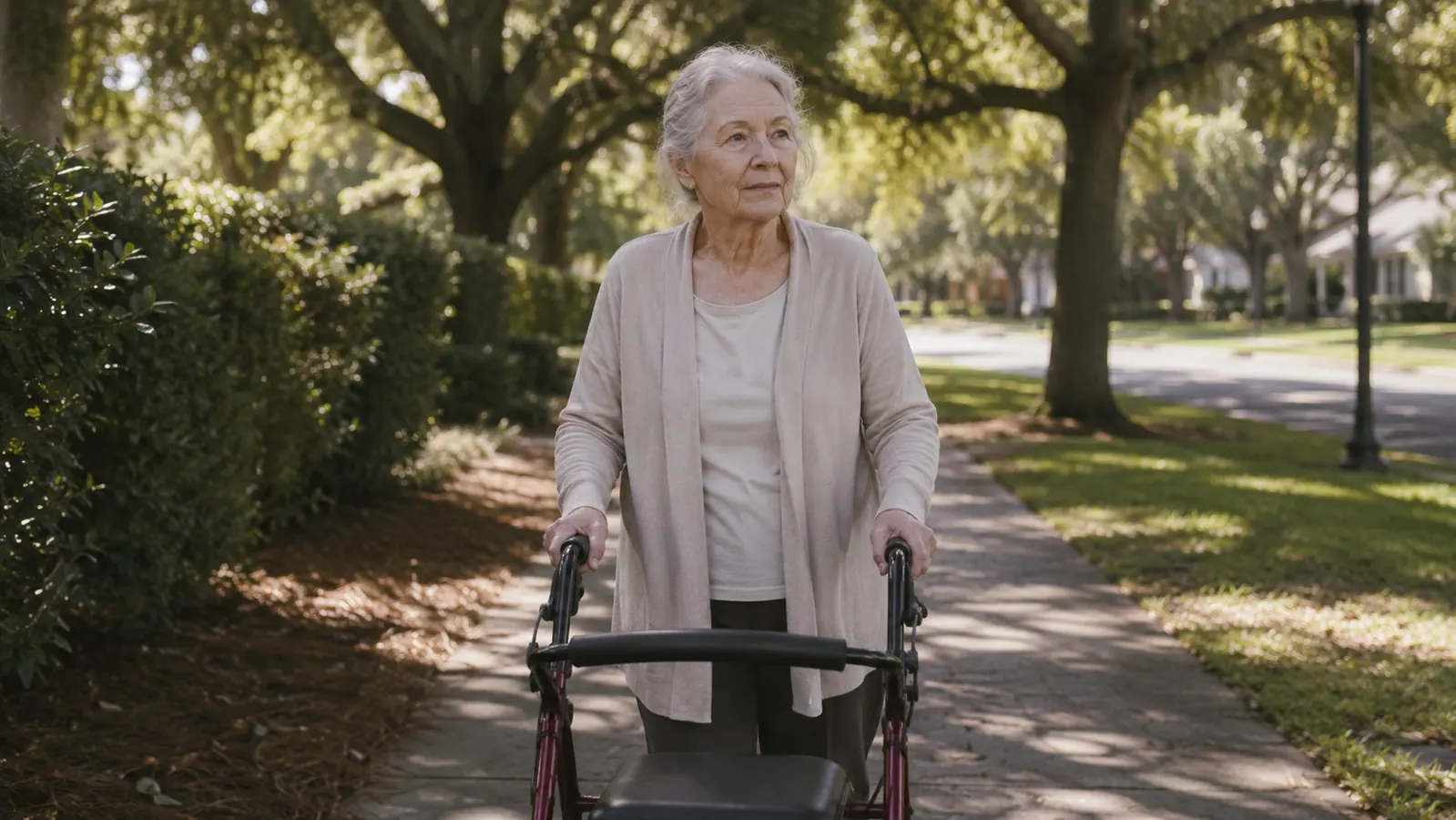
When I first started using a rollator after my leg fracture, I picked one based on the Amazon listing photo and the price. It worked fine in my kitchen and down my hallway. Then I tried to take it to the farmer's market on a Saturday morning, and I understood immediately that I had picked the wrong tool. The wheels were too small for the uneven parking lot pavers. The seat was too low to rest on comfortably when I needed a break. The brake handles required more hand strength than I had in my right wrist, which was still recovering from its own fracture two years earlier. I turned around and went home.
Choosing a rollator for outdoor use requires a different set of questions than choosing one for indoors. This guide is my attempt to write down what my physical therapist explained to me over several sessions, in the same plain language she used. I am not a doctor. I am a woman in my 70s who has now broken two bones in two separate falls and who is, as a result, unusually motivated to get this right. If you are buying for yourself, or if you are an adult child buying for a parent, this guide will walk you through every decision that actually matters.
If you want to skip ahead: the Drive Medical Rollator is what I use outdoors and it gets the key specs right.
It has 8-inch wheels, a loop-lock brake for parking on slopes, a padded seat at a useful height, and it folds flat for car trunks. Over 50,000 Amazon reviews, rated 4.6 out of 5 stars.
Amazon Check Today's Price on Amazon →Step 1: Decide Where You Actually Plan to Use It
Before you look at a single product listing, write down the specific places you want to go. Not a vague idea like "outside" or "around the neighborhood." I mean: the grocery store parking lot, the walking path at the park three blocks away, your daughter's backyard patio, the church fellowship hall with the heavy doors. The surfaces you'll encounter and the obstacles you'll face should drive every spec decision you make.
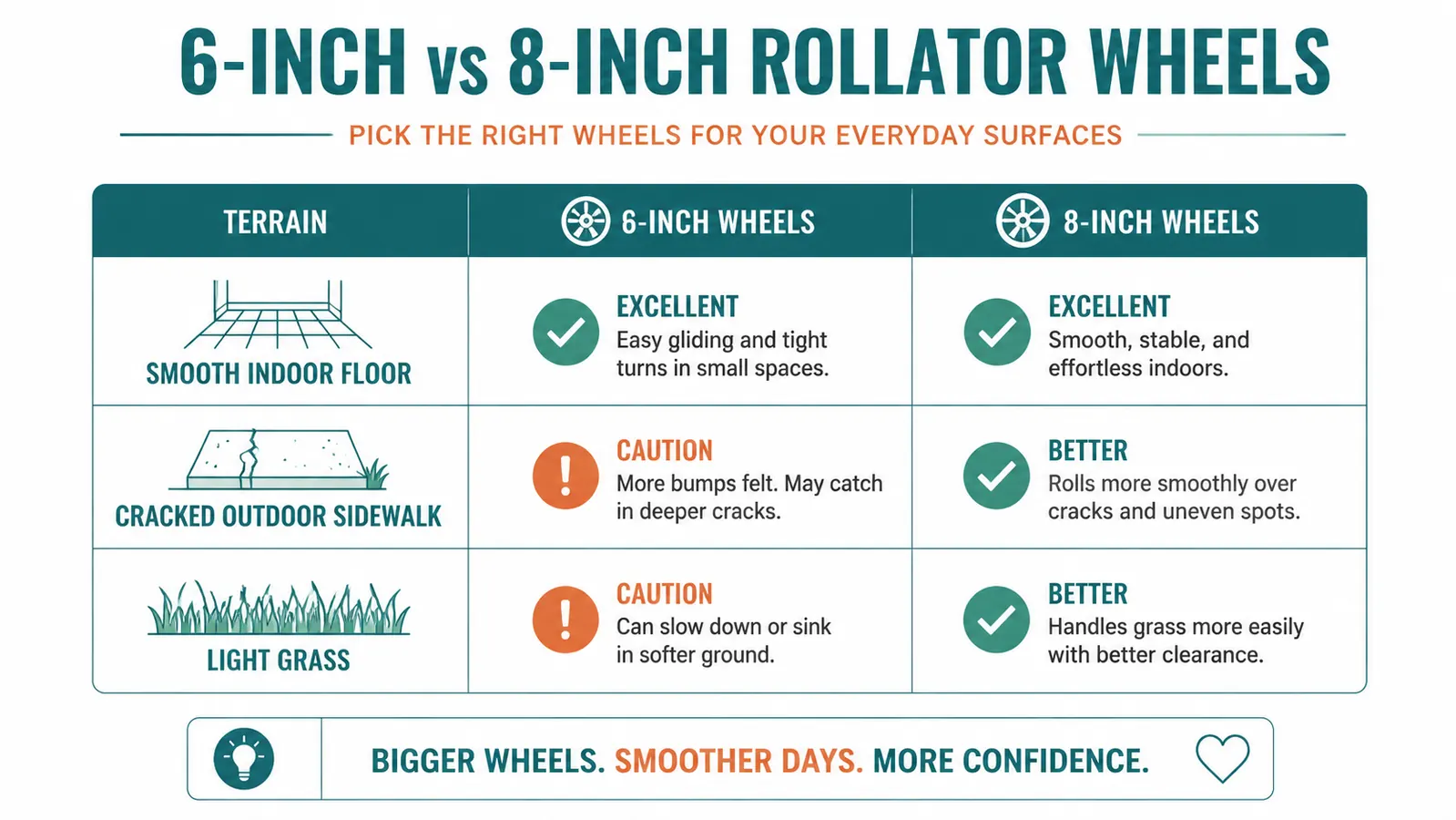
Indoor rollators are typically built for smooth floors: tile, hardwood, low-pile carpet. They often have 6-inch wheels, which roll beautifully in those environments. The moment you hit a sidewalk crack, a parking lot seam, a slightly muddy gravel path, or an uneven patio stone, a 6-inch wheel will catch and lurch. That lurch is exactly the kind of unexpected destabilization that causes falls. If your terrain is mostly smooth but occasionally includes a parking lot or a garden path, you need larger wheels and a sturdier frame.
Make two columns on a piece of paper: smooth indoor surfaces, and everything else. If the second column has even two or three entries, treat this as an outdoor rollator purchase and continue through the remaining steps.
Step 2: Understand Wheel Size and Why 8 Inches Changes Everything
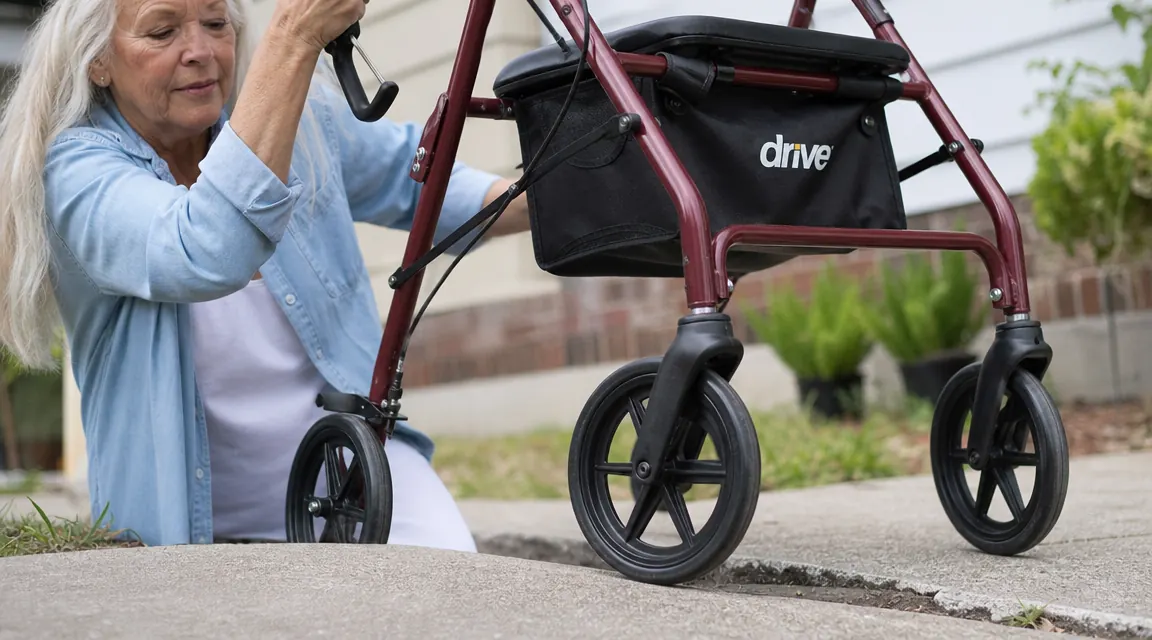
My PT put it this way: wheel diameter is to a rollator what tire size is to a car. A compact car can handle a highway fine, but put it in a field and you'll understand why farmers drive trucks. The larger the wheel, the more easily it rolls over surface irregularities instead of catching on them. For outdoor use, 8-inch wheels are the practical minimum. Some heavy-duty outdoor models go to 10 or 12 inches, which is worth considering if you spend time on grass, gravel, or unpaved paths.
The Drive Medical rollator I use has 8-inch front swivel wheels and rear wheels of the same diameter. I have taken it over cracked sidewalks, across a graveled church parking lot, and around a brick-paved outdoor market. None of those surfaces gave it trouble. When I switched from my original 6-inch-wheel model to this one, the difference was immediate and obvious. I stopped feeling like I had to scout the path in front of me for cracks. That constant visual scanning had been exhausting, and I had not even realized how much mental energy it was costing me until it stopped.
Step 3: Test the Brake System Before You Buy
There are two kinds of brakes on most rollators, and the difference matters enormously for outdoor use. The first type is a squeeze brake: you squeeze the handle to slow down, the way you would on a bicycle. This works well on flat ground. The second type is a loop-lock system: the brake handle has a secondary position where you can lock it in the engaged position, so the wheels cannot roll. This is what you need when you sit down on the rollator seat, or when you are standing on a sloped surface and need the walker to stay put while you rest.
Outdoors, you will encounter slopes. Driveways pitch toward the street. Parking lots are rarely perfectly flat. Church entrances often have a small grade. If your rollator only has squeeze brakes and not a loop-lock, you have to keep squeezing while you sit or stand, which requires grip strength that many seniors, including me after my wrist fracture, do not reliably have. Look for a rollator with loop-lock brakes. Most quality outdoor models include them, but read the product description carefully because it is not always stated clearly.
If you are buying for a parent and cannot test the brakes in person, check the reviews specifically for comments about brake strength and loop-lock function. The Drive Medical rollator's loop-lock works with a simple push down on the handle. I can do it with one hand, which matters to me because my right hand is still weaker than my left.
Step 4: Match Handle Height to the User's Actual Wrist Position
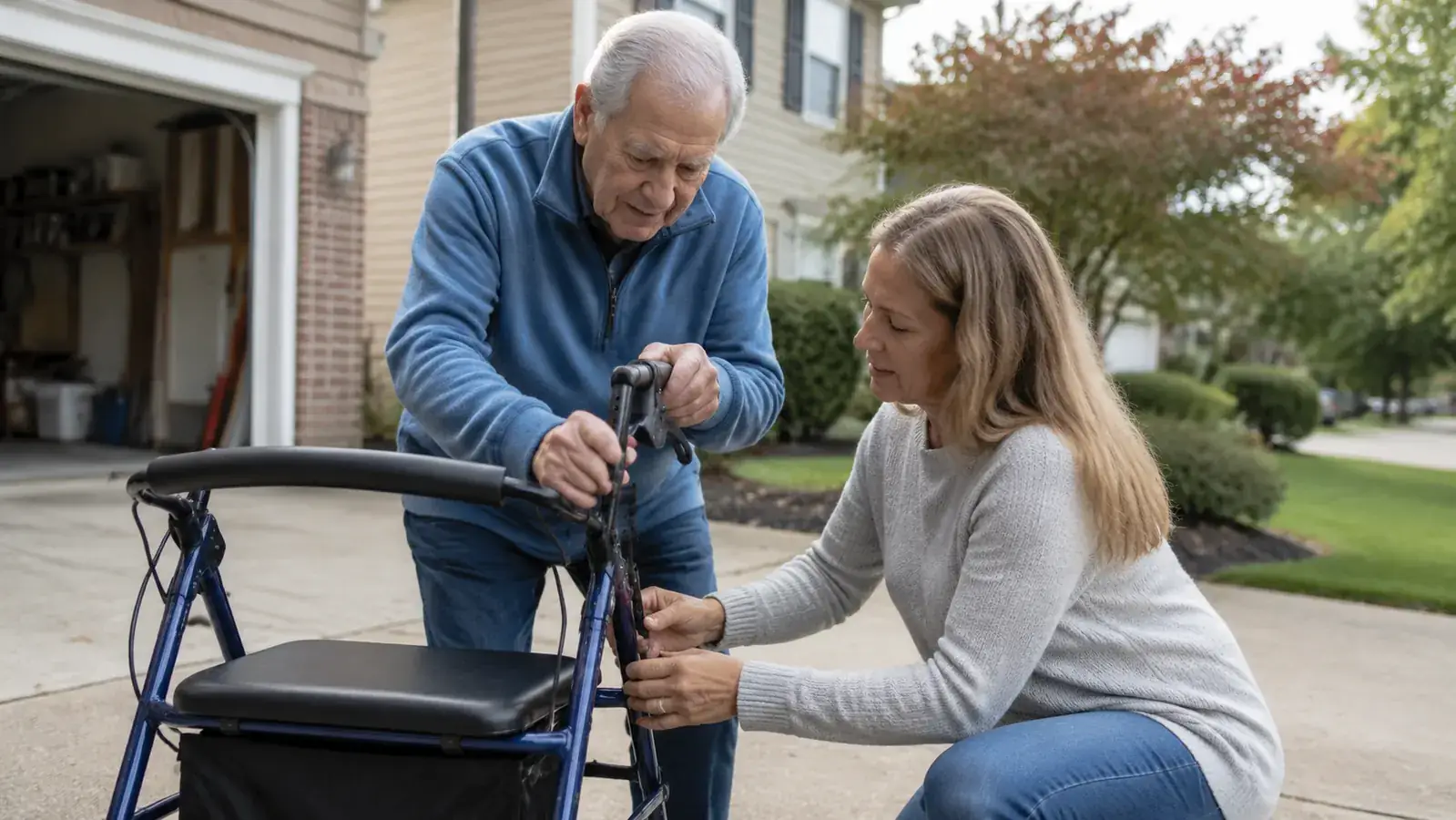
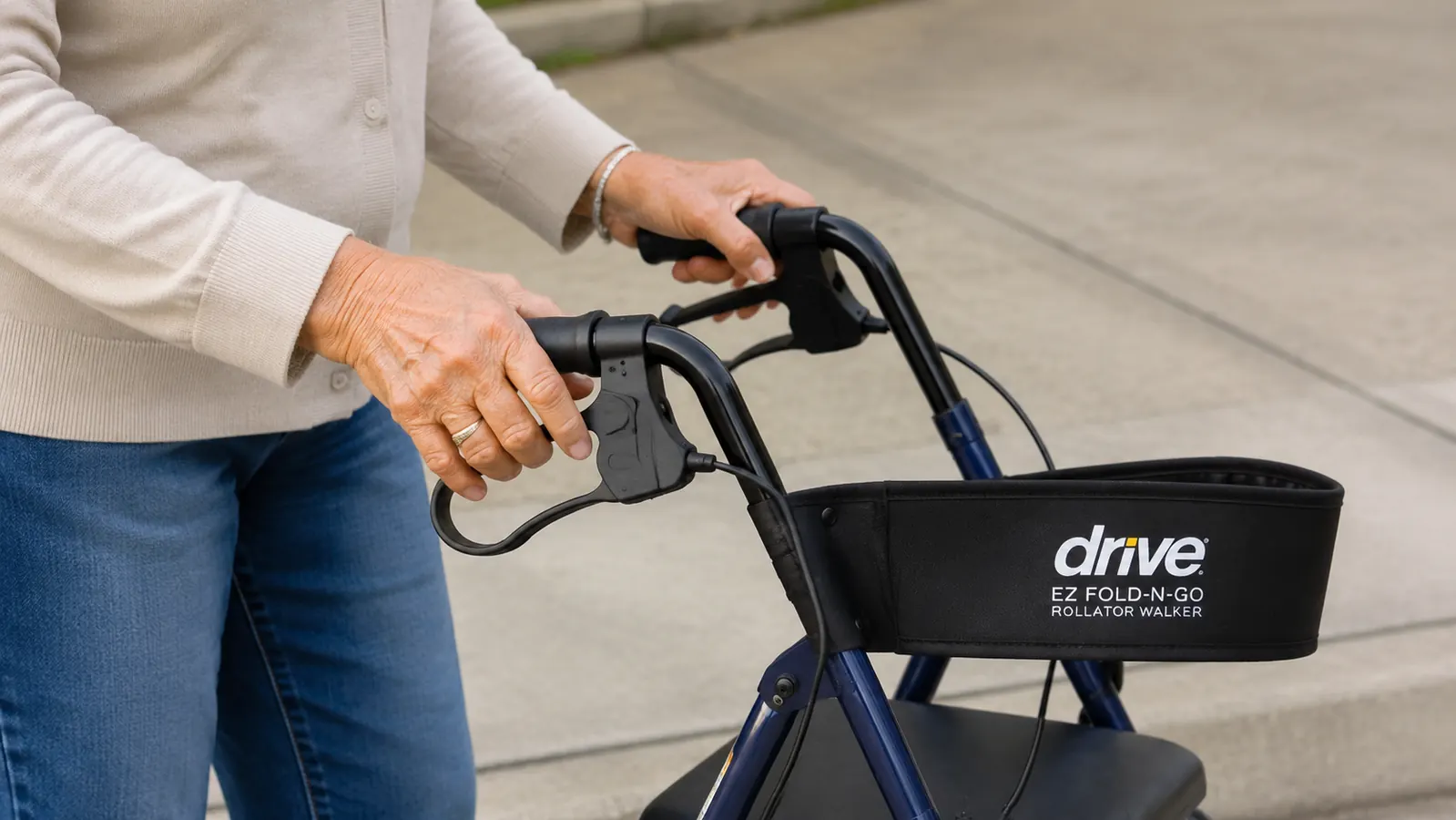
Handle height is not just a comfort question. It is a safety question. If the handles are too low, you lean forward, which shifts your center of gravity ahead of your feet and increases your fall risk on uneven terrain. If they are too high, you shrug your shoulders while walking, which creates fatigue and reduces your ability to control the walker. The correct height places your wrists at a natural bend when your arms hang loosely at your sides. Most people can measure this at home: stand straight, relax your arms, and measure from the floor to your wrist crease. That number is your handle height target.
All adjustable rollators give you a range. The Drive Medical rollator adjusts from roughly 32 to 37 inches, which covers most adults. Where people go wrong is buying a rollator and never adjusting it from the factory setting. My PT makes a point of checking handle height at every session. She has had patients come in complaining of shoulder pain and neck stiffness that was entirely caused by a walker set two inches too high or too low. When you receive a rollator, adjust it before the first walk, not after a week of using it wrong.
The correct handle height places your wrists at a natural bend when your arms hang at your sides. Most people never adjust the rollator from the factory setting. My PT says that single mistake causes more pain than almost anything else she sees.
Step 5: Check the Seat Height and Weight Capacity for Real-World Resting
One of the things I value most about using a rollator outdoors is the built-in seat. When I walk to the farmer's market, I need to sit down twice along the way. Without a rollator, I had stopped doing that walk entirely because I could not find a bench at the right stopping points. The rollator seat changed that. But only because the seat height was appropriate for me.
A seat that is too low requires you to drop down into it and then push hard to get back up, which is hard on knees and difficult if you have had any hip surgery. A seat that is too high means your feet dangle, which is unstable and uncomfortable. The target is a seat height that allows you to sit with your feet flat on the ground and your knees at roughly a right angle, the same standard used for dining chairs. For most people this is between 18 and 22 inches from the ground. The Drive Medical rollator's seat sits at about 22 inches, which works well for me at 5'4". If you are shorter, check this measurement specifically.
Weight capacity matters too. The Drive Medical rollator is rated for 300 lbs, which is sufficient for most adults. If you are looking for a bariatric option, you will need to search specifically for that, as standard rollators cap around 250 to 300 lbs and the frame construction for higher capacities is genuinely different.
What Else Helps When Using a Rollator Outdoors
Beyond the rollator itself, a few additional things made my outdoor walking safer and more sustainable. First, I started wearing shoes with a wider toe box and a low heel. My PT had been telling me this for months and I had been ignoring her. The day I finally bought a proper pair of walking shoes, my confidence on uneven ground improved noticeably. The rollator gives you support from above, but your feet are still the foundation.
Second, I keep a small bag attached to the rollator frame with a water bottle, my phone, and a folded rain poncho. Most rollators have a wire basket under the seat or loops on the frame for a bag. The Drive Medical rollator has both. The ability to carry things without holding them in my hands matters more outdoors than in, because I need both hands on the handles any time the terrain changes. Adult children buying for a parent: get a rollator bag or basket if the model does not come with one. Their ability to carry their own things is part of their independence.
Third, if your parent or family member is nervous about using a rollator in public, that hesitation is real and worth taking seriously. When I first started using mine, I felt embarrassed. I am being honest with you because I think a lot of people feel that and nobody says it out loud. It took me about three weeks of using it before I stopped thinking about it. What helped was going somewhere I felt comfortable first, my neighborhood, not the crowded grocery store. Build the habit somewhere low-stakes. For more on why rollators help seniors maintain activity, this article walks through ten specific reasons in plain language.
Finally, if you have had a fall already, and many people reading this have, I want to say plainly: fear of falling again is a legitimate concern. It is not irrational. Falls are the leading cause of injury in older adults and a second fall is a real risk. A well-chosen rollator, used consistently, is one of the most practical things you can do. But I would also strongly encourage working with a physical therapist if you can, because PT taught me things about how I was walking that no product could fix. The rollator and the PT work together, not in place of each other.
The Drive Medical rollator gets the outdoor specs right at a price that makes sense.
Eight-inch wheels, loop-lock brakes, adjustable handles from 32 to 37 inches, padded seat, wire basket, and a fold-flat frame for car transport. It has over 50,000 Amazon reviews at 4.6 out of 5 stars. If you want a full deep-dive on how it held up over more than a year of daily use, read my long-term review here.
Amazon Check Today's Price on Amazon →