

I bought my Drive Medical rollator about a year and a half ago, not long after my second fall. Before I clicked the button, I did what most people do: I read the reviews. The problem with 50,000 reviews is that you drown in them. The five-star ones are mostly people who just got theirs out of the box. The one-star ones sound terrifying. What I couldn't find was someone who had actually used the thing for a year and could tell me which complaints were worth worrying about and which ones I could safely ignore. So that's what I'm going to be for you today.
I'm Ginny. I'm in my early seventies. I broke my wrist in one fall and my leg in another, and those two events reorganized my entire life. I went through physical therapy twice, lost 48 pounds through diet and exercise, and spent a solid year reading everything I could find about fall prevention. I say that not to impress you but to explain why I take this particular category of product very seriously. A rollator is not a lifestyle purchase. It is a safety device. The five-star crowd does not always treat it that way.
The Quick Verdict
Genuinely good rollator for the price, but it has two real failure points you need to know about before you buy, one fixable at home, one that determines whether this model fits your body.
Amazon Check Today's Price →If your parent is putting off getting a rollator, the wait is the risk.
The Drive Medical is the most widely used rollator in this price range. Check today's price on Amazon and see the current stock and color options.
Amazon Check Today's Price on Amazon →How I Approached This Review
I spent one Saturday morning going through every one-star and two-star review I could find on Amazon for the Drive Medical rollator. There were just over 2,100 of them out of more than 50,000 total, which puts the negative rate around four percent. That number sounds reassuring until you realize that four percent of 50,000 is still a lot of frustrated people, many of them elderly, many of them trying to navigate a return process they didn't want to deal with.
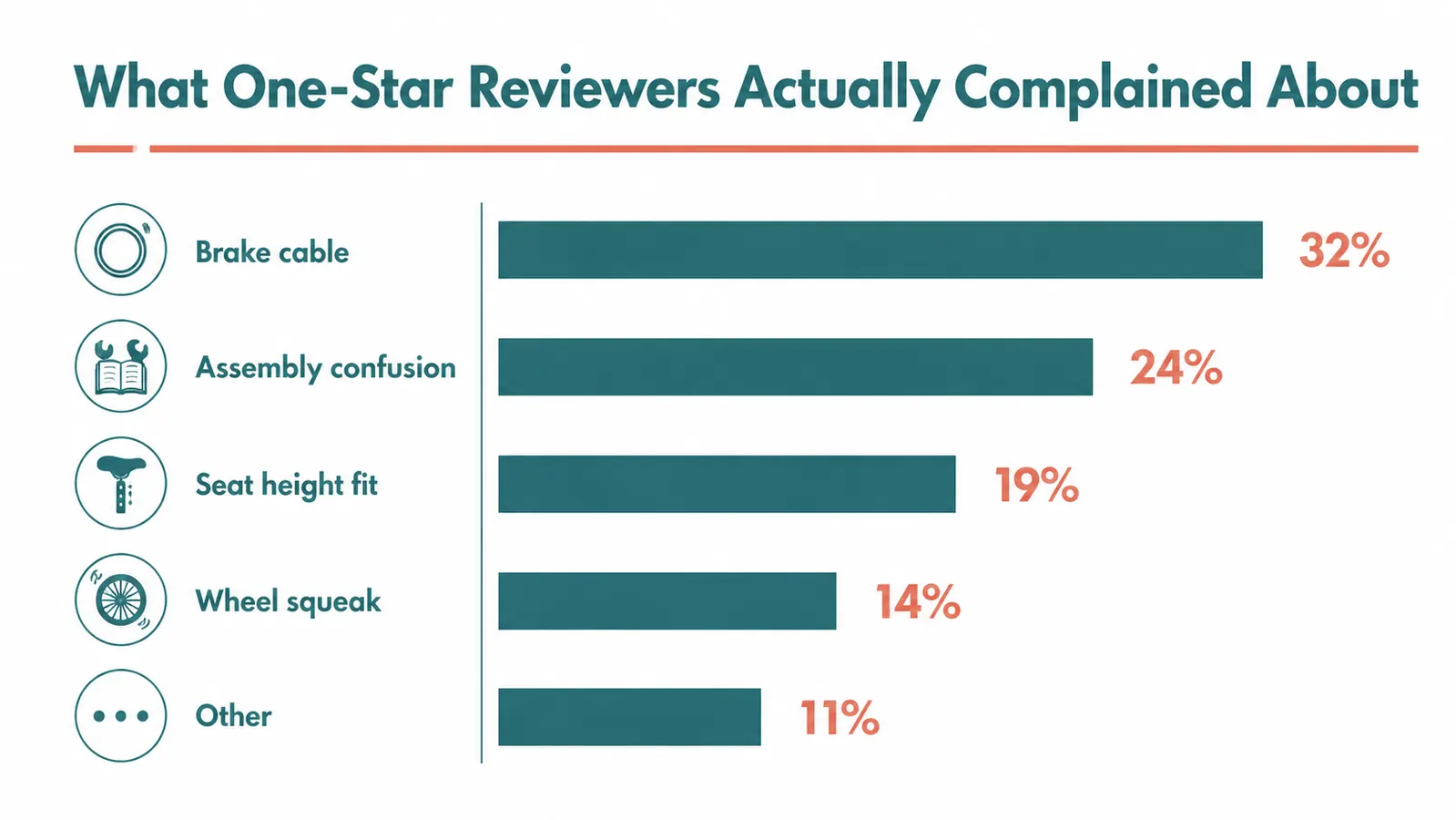
What I found is that the complaints cluster into a handful of repeating themes. Some of those themes describe real product problems. Others describe user problems, things that are frustrating but solvable if you know what to expect. And a few describe a genuine mismatch between what the buyer needed and what this model actually provides. I'm going to walk through each category honestly.
I also want to be clear about what this review is not: it is not my long-term daily-use narrative. I wrote that separately over at my 14-month daily-use review, which covers things like outdoor performance, fold frequency, and how the frame held up. This piece is specifically about the complaints. What are people upset about, and should you be worried?
The Brake Cable Problem: This One Is Real
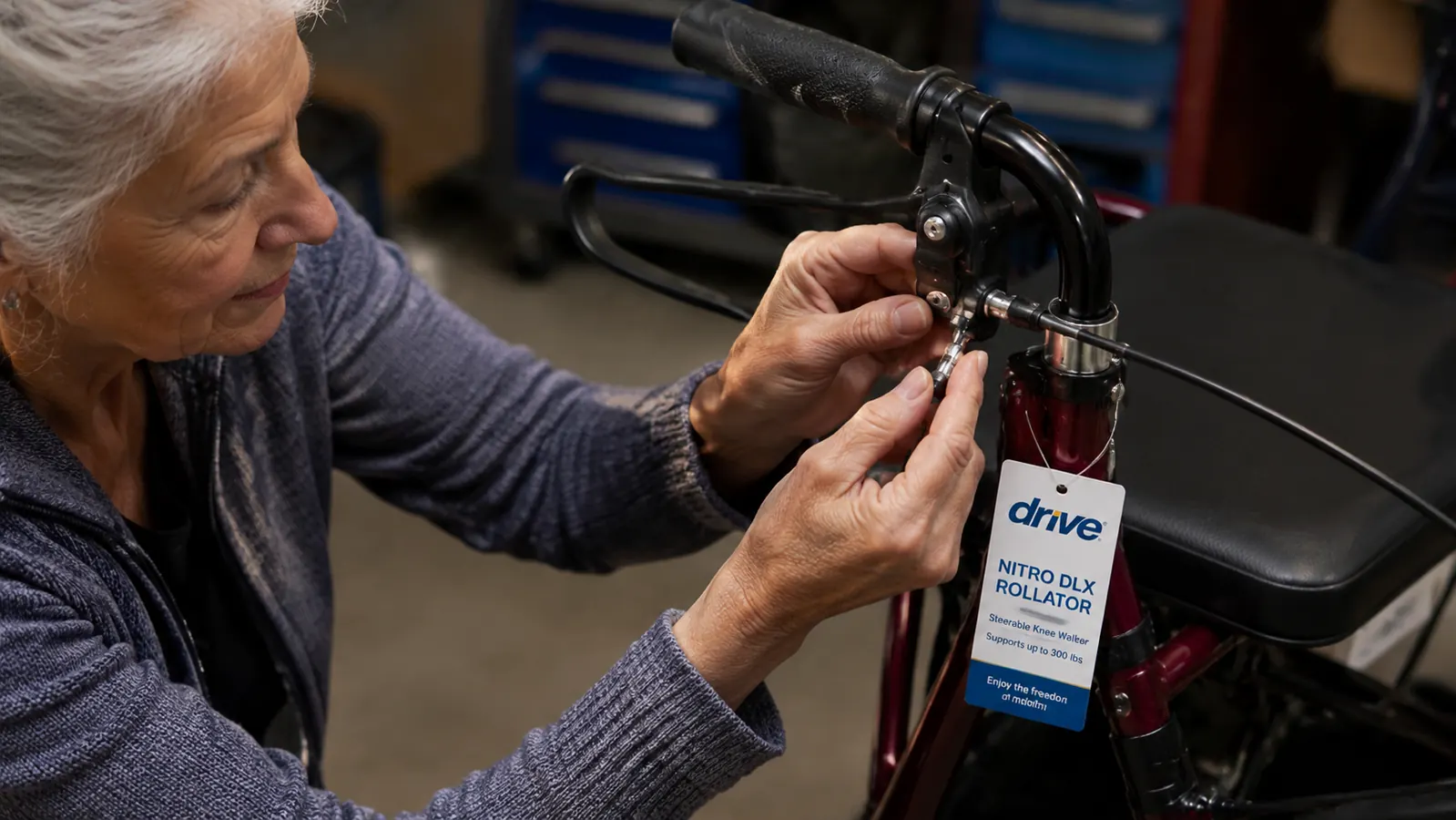
The most common genuine complaint, and by genuine I mean one that describes an actual product flaw rather than user error, is that the brake cables can loosen over time. Specifically, the ferrule where the cable meets the hand lever can work itself loose with repeated use, which means your brakes become less responsive. For a rollator, that is not a small thing. The brake is what keeps you from rolling forward when you sit down or going too fast on a downhill slope.
Here is the part that the one-star reviewers don't always mention: this is fixable, and it takes about three minutes if you have a small screwdriver. My PT mentioned it to me before I even noticed the problem. She had seen it enough times with her other patients that it was on her standard checklist. You tighten the barrel adjuster on the brake lever, there's a small knob you turn counterclockwise, and it takes up the slack. You should check this every few months regardless. I put a reminder in my phone. But Drive Medical's documentation does not explain this clearly, and that is a fair criticism of the company.
The brake cable loosening isn't a design flaw so much as a maintenance reality. Every bike owner knows you have to adjust cables. A rollator is the same principle. The problem is that nobody tells you that before you buy.
The Seat Height Issue: This One Might Be a Dealbreaker
The second major complaint category is seat height, and this one is not fixable. The standard Drive Medical rollator has a seat height that adjusts within a limited range. The exact numbers depend on the model variant, but the seat on the standard size typically lands between about 19 and 21 inches from the floor. If you are taller than 5 feet 7 inches or so, you will likely find the seat too low. If you are shorter than 5 feet, you may find the handlebars, even at their lowest setting, still too high.
I am 5 feet 4 inches and the standard model fits me fine. My neighbor Rosalie is 5 feet 10 inches and she returned hers within a week. Drive Medical makes a tall version and a petite version of this rollator, and those variants actually solve the problem. But a lot of people order the standard without checking the sizing chart, and then they write a one-star review. The product is not wrong. The match is wrong. This is a purchasing decision, not a product defect.
If you're buying this for a parent: measure them. Not just their height, but their elbow height when their arm hangs naturally at their side. The handle should meet their wrist when they're standing upright, without making them hunch or reach up. If you get that right, the seat will almost certainly be in an acceptable range too. If you get it wrong, nothing else about the rollator matters.
Assembly Complaints: Mostly a Non-Issue With One Exception
The second most common complaint category is assembly difficulty. I'll be honest: this one surprised me when I read it, because I assembled mine by myself in about 25 minutes, and I am not mechanically inclined. The instructions are not great, they're the kind of line-drawing manual that makes you feel like you're squinting at a diagram from 1987. But the actual assembly is not complex. You attach four legs, connect two brake cables, and adjust the height. That's essentially it.
The exception is the brake cable connection. Threading the cable end through the small slot in the brake handle requires decent finger dexterity and good eyesight. For someone with arthritis in their hands or early macular degeneration, this step is genuinely hard. Several reviewers mention asking a neighbor or family member to help with just this one part. That's reasonable advice. The rest of the assembly is straightforward.
The Squeaking Wheel: Annoying, Not Dangerous
About fourteen percent of the negative reviews mention a squeaking wheel, usually appearing after several months of use. Mine started doing this around month eight, specifically the rear left wheel. The squeak was worse on smooth indoor floors than on pavement. I found that a few drops of silicone spray (not WD-40, silicone spray) at the wheel axle fixed it completely and it hasn't come back in four months.
I mention the silicone spray specifically because several people say they tried WD-40 and it only helped for a day or two. WD-40 is a solvent, not a long-term lubricant. Silicone spray stays put. A small bottle costs a few dollars and it's worth having for any wheeled equipment in the house. This is a maintenance issue, not a structural one.

What the One-Star Reviewers Get Right About the Seat
There is a legitimate complaint buried in the seat reviews that I want to pull out, because it took me a while to notice it myself. The seat on this rollator is firm and narrow. The width is about ten inches. For someone who carries weight in their hips, or who has any kind of sacral tenderness from a previous injury, extended sitting on this seat is uncomfortable. It's fine for a rest of five or ten minutes. It's not a chair you want to sit in for twenty minutes at an outdoor market.
I bought a small memory foam seat cover that attaches with elastic straps. Cost me under $15 and it made a noticeable difference. But again, the product description does not mention seat width or comfort, and buyers who assume a rollator seat is a comfortable resting spot are going to be disappointed. Manage expectations here. The seat is there so you don't have to find a wall to lean on. It is not a park bench.
What I Liked
- Brake mechanism is solid and easy to adjust once you know how, just takes knowing the barrel adjuster trick
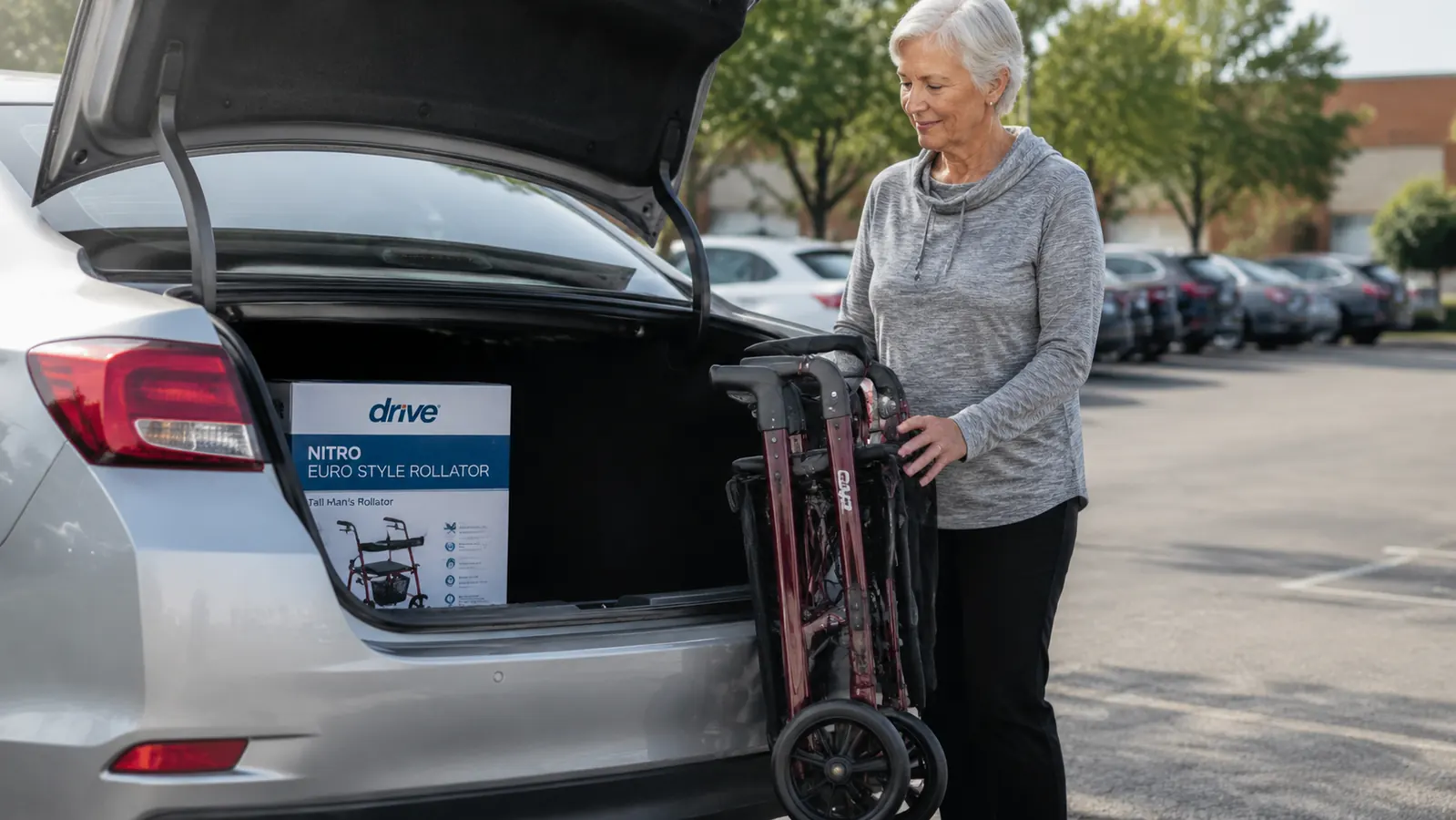
- Folds flat quickly for car travel; fits in most standard trunk sizes without any wrestling
- Under-seat bag is genuinely useful and large enough for a purse or a small grocery bag
- Frame weight is low enough that most seniors can lift it unassisted, important for getting in and out of cars
- 50,000-plus buyers means a deep secondary market of replacement parts and accessory options
- Height adjustable handles accommodate a reasonable range without tools, just press the button and slide
Where It Falls Short
- Brake cables require periodic tightening; the manual doesn't explain this and it will catch you off guard if your PT doesn't mention it
- Seat is firm and narrow, adequate for short rests, not comfortable for extended sitting without an aftermarket pad
- Assembly cable threading step requires decent dexterity; anyone with significant hand arthritis should get help with that one step
- Standard size seat height range doesn't fit taller adults, verify your sizing before ordering, not after
- Rear wheel squeak can appear after six to twelve months of use; silicone spray fixes it but you have to know to do it
Who Should Buy This and Who Should Not
Buy the Drive Medical rollator if you are between 5 feet and 5 feet 7 inches tall, you need a rollator that folds for regular car transport, you want something that has been on the market long enough to have a known maintenance profile, and you are not expecting a luxury experience. At the current price on Amazon, it is one of the best values in the category. The complaints are real but they are manageable once you understand what you're dealing with.
Skip it if you are significantly taller than 5 feet 7 inches (look at the Drive Medical Tall version or the Medline Empower rollator instead), if you have severe hand arthritis that would make any cable adjustment difficult without help, or if you need a rollator with a padded seat for outdoor use where you'll be sitting for more than a few minutes at a time.
If you're an adult child buying this for a parent: please measure their elbow height before ordering. Call them. Get out a tape measure together over video. Get the size right and this rollator will serve them well. Get it wrong and you will both be dealing with a return process neither of you wants. You can read more about how rollators compare to standard walkers in my piece on rollators versus standard walkers, which also covers when a rollator is not the right choice at all.
The Complaint I Take Most Seriously
Out of everything I read, the complaint that stayed with me most was from a woman whose mother had the rollator tip sideways when she sat down on it while it was moving. The rollator is not designed to be sat on while in motion, you're supposed to stop, engage the brakes, and then sit. But the design doesn't make that sequence obvious, especially for someone who is rushing because their balance is already off. The five-star crowd doesn't talk about this because they followed the instructions or got lucky.
If you are buying this for a parent, spend fifteen minutes with them when it arrives. Walk through the sit-down sequence together. Show them how to squeeze both brakes before they commit their weight to the seat. This is not a criticism of the product specifically, it applies to every rollator. But it's the kind of thing that doesn't appear in the product description and absolutely should. A rollator seat is not a chair that happens to be attached to your walker. It is a feature that requires a learned behavior to use safely.
My Bottom Line After Reading All of It
The Drive Medical rollator is a good product being reviewed by a population that sometimes doesn't know what it's buying and sometimes buys the wrong size. The genuine product problems, the brake cable loosening and the rear wheel squeak, are real, but they are maintenance issues, not structural failures. I have had mine for over a year, I use it several times a week at minimum, and the frame is solid. Nothing has bent, cracked, or broken.
The seat height issue is the one that would actually stop me from recommending it to a specific person. If you are tall, get the tall version. If you are in a normal height range and you're comfortable doing occasional minor maintenance (or having someone do it for you), this rollator will do its job and keep doing it. At the current price, it's hard to argue against it as a starting point for someone who needs mobility support and isn't sure yet how much they'll rely on it.
What I wish someone had told me before I bought mine: check the brake cables every three months, use silicone spray on the wheels if they squeak, buy a seat pad if you plan to sit on it for more than a few minutes, and spend a practice session with your parent before you call it done. Do those four things and most of the one-star complaints simply will not apply to you.
The brake cable trick and the seat pad are not in the box. The rollator itself is worth the price.
Check today's price on Amazon and look at the color and size options. The tall variant is listed separately, look for it if your parent is over 5'7".
Amazon Check Today's Price on Amazon →